Every moment is a golden one for him who has the vision to recognize it as such.” ( Henry Miller )
Ruth and I embark on our road trips west to California from Fort Lauderdale always looking for those sites that seem both freshly new and spiritually uplifting. These lofty goals though seem tough to accomplish when we average 400-500 miles driving each day on our typically prearranged schedule to reach the “Golden State” end of our journey. Know then we’ve reached the logical conclusion that fly/drive adventures make more sense now to cover desired regions of the U.S. in greater depth than we’ve previously undertaken. So we’ve been out on the road moving south along the California coastline from the San Francisco Bay Area since late May. For this particular blog, then, I invite you to relive with us some inspiring video moments of “California Golden” scenes that we’ve witnessed so far on this more time abbreviated adventure. Just click on the six (6) links below that follow each caption.
1.Elephant Seals Along the Central California Coastline CD
“The way you get a better world is you don’t put up with substandard anything.“ (Joe Strummer)
My last blog posting demonstrated how a seemingly enticing airboat ride in the Florida Everglades could easily be delivered to tourists from a substandard selling perspective, Thus, for this latest entry, I continue this theme below by analyzing ten (10) places we’ve visited on past road trips that similarly do not measure up to the desired tourist quality that I expected to enjoy. I then place my trust in some comparable sites below that seem to be better suited for me from a self guided travel perspective.
1. Bourbon Street, New Orleans
I’ve learned to avoid the raucous party reputation of this thirteen block corridor when seeking lively entertainment options in New Orleans on our road trips. For does one really need to tangle with this often crowded tourist frenzy seeking overindulgence in sinful pleasures. You might instead look elsewhere for a decent place to dine at affordable prices and perhaps a jazz performance of musical quality to follow.
Better Choice: Frenchman Street Corridor
This relatively compact entertainment district within walking distance of Bourbon Street is well known to the “locals” in New Orleans as the trendy area to go for serious listeners of live music of jazz, rock, reggae, and blues genres. On our recent visit to “The Big Easy” we’ve also found the Frenchman corridor easier to find parking, much safer to walk here and definitely more relaxing than the Bourbon street nightly chaos.
2. St. Augustine, Florida
There are some decent tourist options to visit of authentic historical attention like the Castillo De San Marcos District along the Intercoastal Waterway and the Flagler College annex west of downtown. But beyond these likely first time visit options, St. Augustine seems burdened by a “tourist trap” reputation filled with a hodgepodge of tacky souvenir shops, and uneconomical family tourist options that tend to “stretch the truth” like Ripley’s Believe It Or Not and the Fountain of Youth Museums.
Better Choice: Charleston, South Carolina
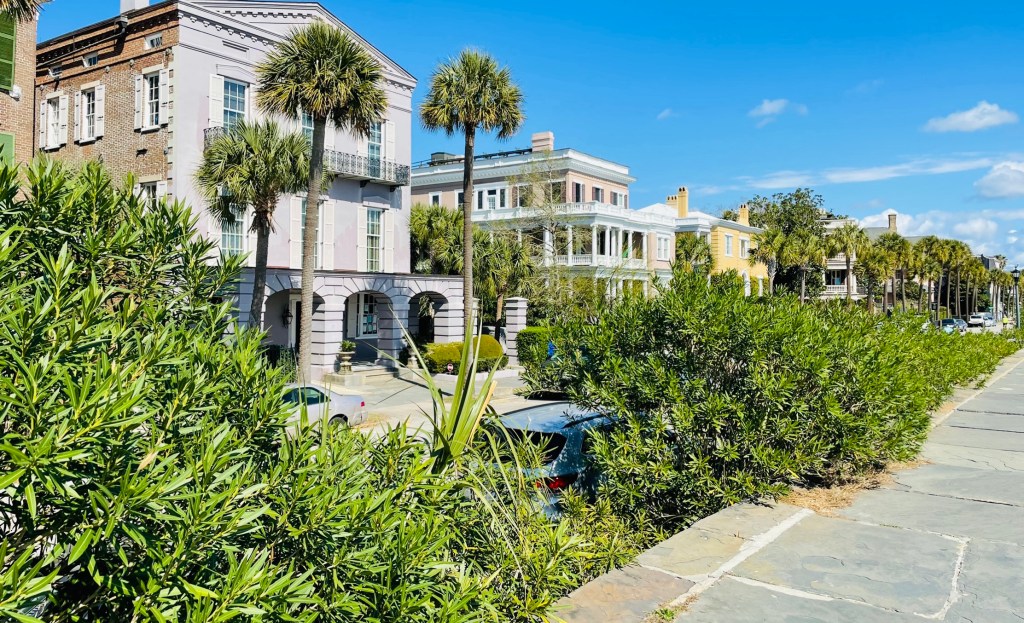
Travel 275 miles north of St. Augustine along the Atlantic coast to Charleston and you can obtain a more authentic sense of American history. Walk along the King Street corridor to view historic colonial structures in Old Town Charleston. Embrace Charleston’s past antebellum legacy as you embark on an easy drive to Magnolia Plantation, shop at the Old City Market, tour the Slave Market, or relax on a scenic boat tour to Fort Sumter,
3. South Beach Strip , Florida
Many young tourists come to South Beach to experience its famous club scene offering one’s choice of all night hedonistic pleasures. But for those who venture beyond this beachfront mecca of Art Deco structural pleasure, a more unglamorous picture of Miami Beach appears. For like so many aging cities across our country , one finds a noticeably “rundown” reality there with plenty of homelessness , poverty, and street crime to concern the visiting tourist today.
Better Choice: The Florida Keys
Avoid the crowded urban chaos of the Miami Beach region by heading south as you proceed from bridge to bridge via the Overseas Highway. For this scenic ride tends to slow one’s busy mind down to appreciate life’s present moment amid such blue ocean bliss. Ask yourself during your Key West, Islamorada or Marathon visit if you really need to be constantly entertained in a big city?
4. Gatlinburg, Tennessee
The “Smokies” would be an ideal place for an exciting summer vacation with over 800 square miles of mountains, streams, and forests. Yet while Gatlinburg serves as the northern gateway to to Smoky Mountain National each year during “high season”, the town seems too small to accommodate the huge throngs of tourists who visit there each year.
Better Choice: Asheville, North Carolina
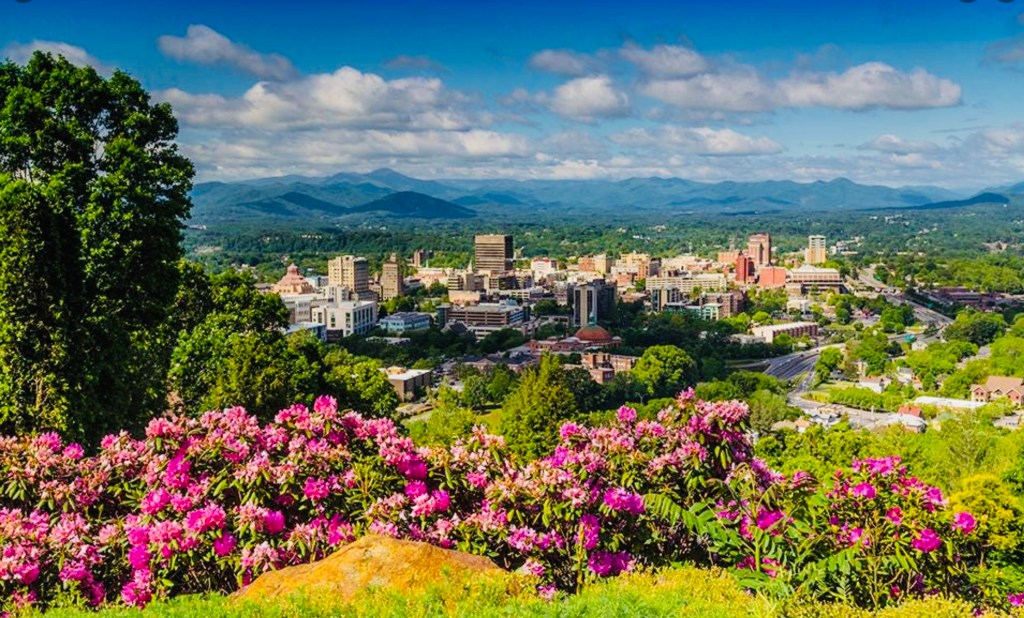
Possessing the same close proximity to Smokey Mountain National Park from the South, Asheville offers the additional advantage of more readily available lodging, dining and shopping options in a much larger city setting. It’s vibrant art scene and Biltmore Estate Tour experience also entice interest for the seasoned traveler.
5. Park City, Utah
Winter skiing can be an expensive proposition especially when it caters to the “jet set” in this“upscale” town of Park City. For the frugal traveler, you thus might face the inconvenience of staying outside of Park City and risk missing out on local ski resort fun.The state of Utah’s Mormon dominant politics might also give one second thoughts about indulging in alcohol, pornography and other so called sinful actions.
Better Choice: Steamboat Springs, Colorado
Do you want to experience the challenge of hiking, rafting, or skiing amid a beautiful mountain setting or do you want to impress your friends about your “high end” indulgences in a prestigious resort town? For you learn in unpretentious Steamboat to embrace the essence of the western frontier on your own terms as a matter of survival first and luxury last.
6. Hollywood, California.
Once considered as the tourist center for movie star glamour in the early days of motion pictures, downtown Hollywood, California offers today merely a casual glimpse of its past film glories. Yes, the Chinese Theater and Star Walk of Fame still survive but the movie stars have moved on to exclusive places of suburban privacy like Malibu Beach, Bel- Air and Laurel Canyon. Of course you will still find hordes of Hollywood curiosity seekers who seem determined to chance a rare encounter with the latest celebrity while overlooking the increasingly blighted look of this historic neighborhood.
Better Choice: Visit a Famed Movie Studio
The American Motion Picture industry in America continues to dominate today from its historic film studios in Studio Center and Burbank locations near Hollywood, California – 20th Century Fox, Warner Bros, Paramount, Columbia and Universal… While tours of these complexes can be costly, they provide a much better chance at coming in close contact with a movie star. If motion pictures or television shows are currently in production, you might even be picked as a movie star “extra” or become an audience participant for a live taping.
7. Flagstaff, Arizona
The “Mother Road” of Route 66 began in 1926 as one of the first highways to cross east – west to California. So in what locations across America can you best view historic remnants of old gas stations, motor hotels, and iconic cafes from Route 66’s iconic past? Not in Route 66 Flagstaff it seems as the road’s spreading urban sprawl look provides merely an unglamorous weigh station for those moving on to the famed Grand Canyon to the north. You might even easily bypass Route 66 altogether if you transport your vehicle conveniently from I-17 north to I-40 west.
Better Choice: Williams, Arizona
Main Street in Williams is a National Historic District showcasing country storefronts unusual curio shops, an old-fashioned soda fountain, classic diners and some retro looking motels, that preserve the essence of the Route 66 bygone era. It’s also a little closer to the Grand Canyon than Flagstaff and forms the terminus of the famed Grand Canyon Railway.
8. Tunica, Mississippi
Tunica’s rise to resort status in the mid 1990s coincided with the popular appeal of casino gambling along the Mississippi River in a desperately poor region of “Deep South” America. While a few of these “grand” hotels still remain to provide a comfortable weekend of gambling fun for commuters from Memphis and other nearby urban areas, there’s not much left to see of the Mississippi Blues Trail culture there. The views of America’s longest river are challenging to find at best as many of these hotels have chosen to restrict public access to Mississippi River scenic vantage points on their private lands.
Better Choice: Vicksburg, Mississippi
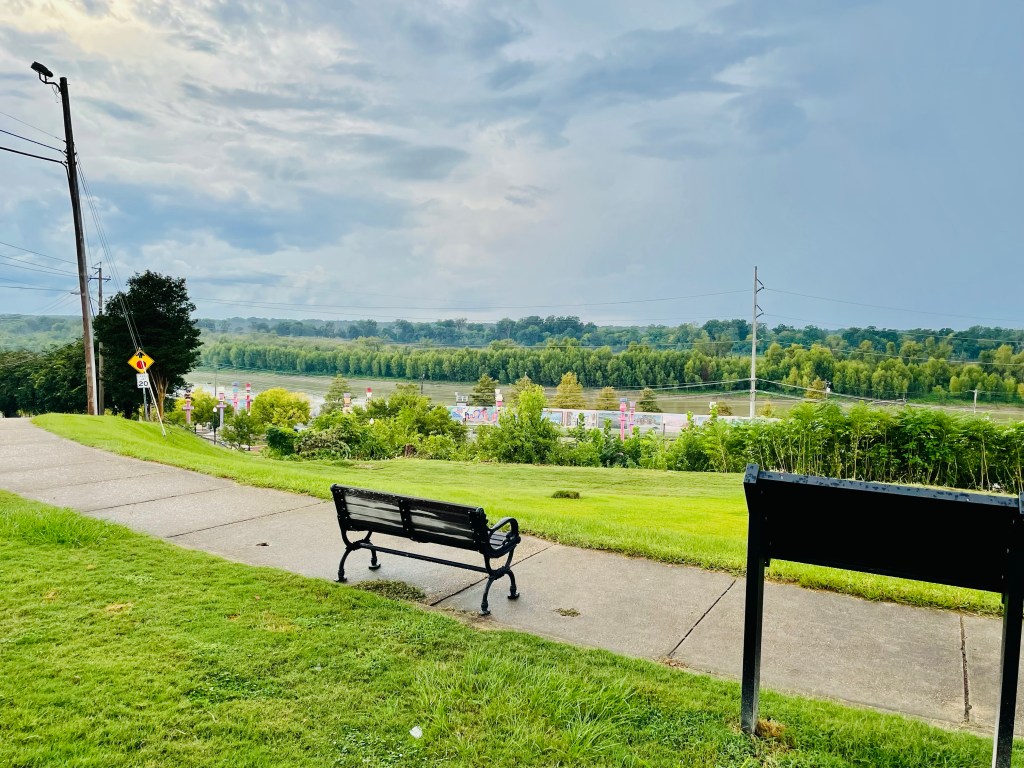
Downriver a few hours from Tunica, Vicksburg, Mississippi in 1864 experienced one of the “turning point “battles of the American Civil war. Situated along steep cliffs overlooking the great Mississippi River, much of this Old Town retains an historic southern aura of these former antebellum times. As you travel along historic Business 61, there are also plenty of turnoffs to descend down the cliffs to obtain an intimate sighting of the river. Driving a few miles east, one can also relive the human tragedy of this deciding battle at Vicksburg National Military Park.
9. Amish Country , Ohio
At this more mature time of my life, I like to reminisce about those countryside camping trips, rural farm visits, and YMCA sports outings I’d experienced as a “kid” in Midwest America. Yet it would not be wise to encroach upon the private Amish people in this region to obtain such a nostalgic dose of one’s outdoor frolicking spirit? For I’ve learned not to infringe upon their ultra conservative ways on my previous visits to small towns like Berlin and Millersburg and would never recommend one try to mimic their horse and buggy lifestyle in their country towns to obtain some childlike fun.
Better Choice: Indiana Dunes National Park
So it seems a better choice to re capture the essence of childhood play as I once experienced in Ohio should take place in a more publicly amenable setting. Thus I would recommend that one head west from Cleveland on I-90 along the shores of Lake Erie to Indiana Dunes National Park. Then find a a quiet spot along these magnificent dunes to play in the sand, throw seashells around, or swim in the cold lake knowing that very few people would be around to bother you.
10. Pagosa Springs, Colorado
In visiting Colorado, accessibility to the Rocky Mountains for active hiking and camping opportunities should be a major reason for an extended tourist stay.Yet Pagosa Springs as observed from a previous visit lies remotely surrounded by thick National Forest and is therefore somewhat inaccessible to the Southern Rockies region. With the landscape of Pagosa Springs being situated so remotely amid quiet suburbia, there’s not much to do from the tourist point of view.The renowned Springs Hot Springs Resort in Pagosa would no doubt provide an enticing place to relax yet it’s much too sedentary an experience for those who wish to indulge in a more active Colorado time.
Better Choice: Durango, Colorado
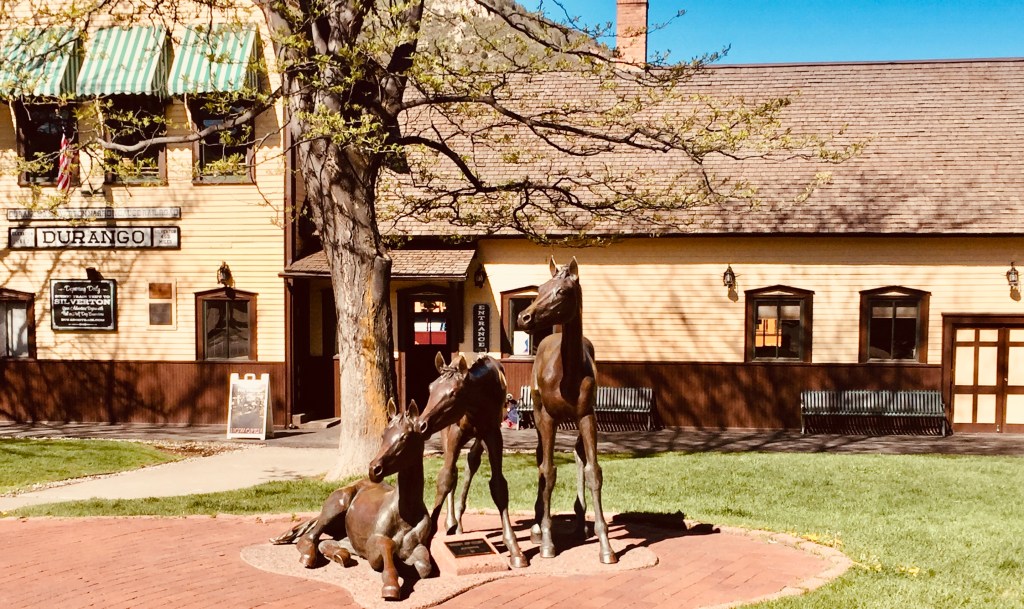
West of Pagosa Springs, The town of Durango provides excellent access to the southerly portion of the Rocky Mountains. In particular, it’s daily steam train service from downtown provides an unforgettable experience to the upper heights of the Rockies at Silverton. Back in downtown, walking along Main Avenue exudes a feeling of time traveling myself back the Old West of cowhands and outlaws roaming the streets. From Durango , accessible routes lead to other interesting natural landmarks like Mesa Verde National Park, Chimney Rock National Park, and popular Utah recreation areas.
“Travel makes a wise man better, and a fool worse.” (Thomas Fuller)
There seemed no better place for Mike to get away from the urban madness of South Florida than this Sunday morning spent alone at his favorite Everglades rest stop quietly munching his sandwich. For he felt such undisturbed environmental conditions here would help him unwind from his stressful commitments as a high school biology teacher that often piled up at the end of the school year.. He also envisioned that some idle study observing this thriving eco-system during the cooler hours before noon would yield some interesting photo shots of migratory birds and reptilian wildlife. After lunch, he might even take some time to slowly reposition myself in yoga mantra position along the adjacent canal to meditate in silence amid this “River of Grass” oasis for awhile.
But then Mike’s uplifting anticipation of nature’s solitude suddenly disappeared when he smelled boat oil followed by the noise piercing engines of a tourist-packed airboat moving quickly near. With no surprise then, this precious eco-system now suddenly became radically disturbed as the resident alligators along the bank now dove into the depths of the now “wake” disturbed canal while feeding herons, anhingas, and egrets scattered nervously into the sky. How unfortunate it seemed to him that this young airboat driver intended to dock his airboat at this location in spite of this disturbing mechanical encroachment upon these pristine yet vulnerable lands. Upon further observations of this ominous environmental scene, the driver in Mike’s view did not seem to care about spreading the word concerning responsible eco- tourism and instead engaged in some extended small talk with the disembarking passengers about about cheap souvenir sales and Indian Joe’s alligator wrestling exhibition
Mike noticed then that some of the tourists complained to each other about practical concerns on this ride such as a lack of restroom facilities and insufficient instructions about how to properly wear their noise deadening headphones. Yet the driver seemed oblivious to their concerns in Mike’s view as he went off to the parking lot on his own to “yak” on his cellphone for the duration of this short stopover. Most importantly, it puzzled Mike that the tourists seemed to be wasting their precious sightseeing time on a high speed ride through these federally protected surroundings while remaining ignorant about the abundance of vegetative and wild life diversity that existed here. So when he heard the loud blare of the airboat engine revving up again, he felt relief that this misguided tour would soon depart. For in a few minutes, Mike’s blissful spot in the Everglades would renew itself as the canal again flowed smoothly and this vast tropical swampland settled back into stillness once more. Mike took comfort then in knowing that the alligators would also return with eagerness to their favorite sand clearing along the canal bank and share their sinister smiles at him once again.
Does the the word “tourist trap” cross your mind in this example? Bingo! These tourists had been scammed of hundreds of dollars for an inferior waste of their airboat time. For it seems logical that the proprietors of this airboat company obviously planned a fast “ripoff” of these clueless tourists knowing full well that the quality of their Florida Everglades experience would be shoddy at best. So as a veteran road tripper of cross country road trips in the past ten years, I urge my blog readers to be beware of such scams of substandard services provided in your future summer travels.
“ These gardens give us the hope and serenity that emanate from the beauty of the earth.” (Eleanor and Eugene Goldberg)
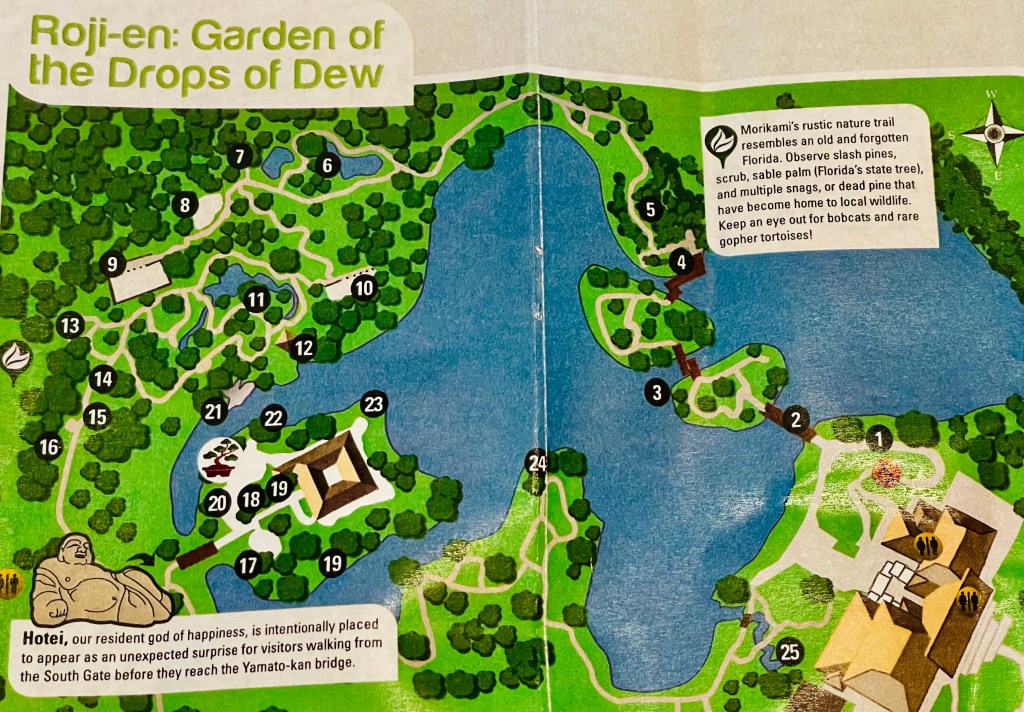
As I eagerly await our next road trip to California later this month, perhaps you’ve noticed that I’m spending more time investigating local tourist spots in my own home territory of South Florida. For in paraphrasing from the introduction to my blog home page, any place near or far will do if your senses are open to the peaceful energy that surrounds you. So I headed north on busy I-95 on Saturday morning last week, then veered west through swanky Boca Raton to spend an amazing two hours meandering around the sixteen acre environs of Morikami Gardens.
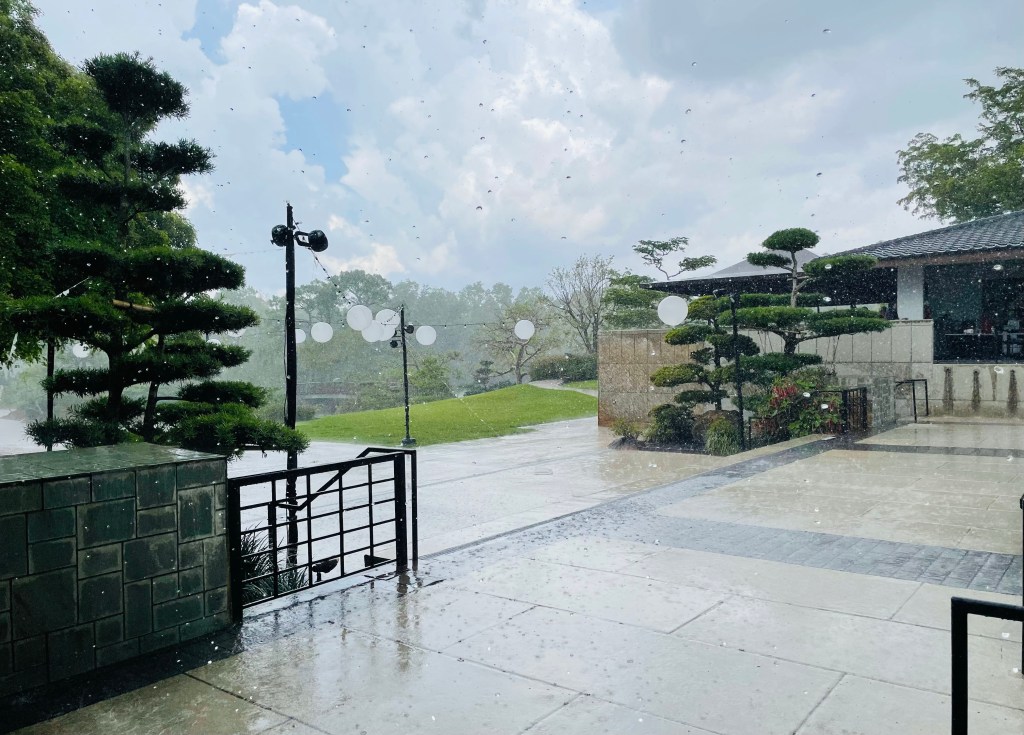
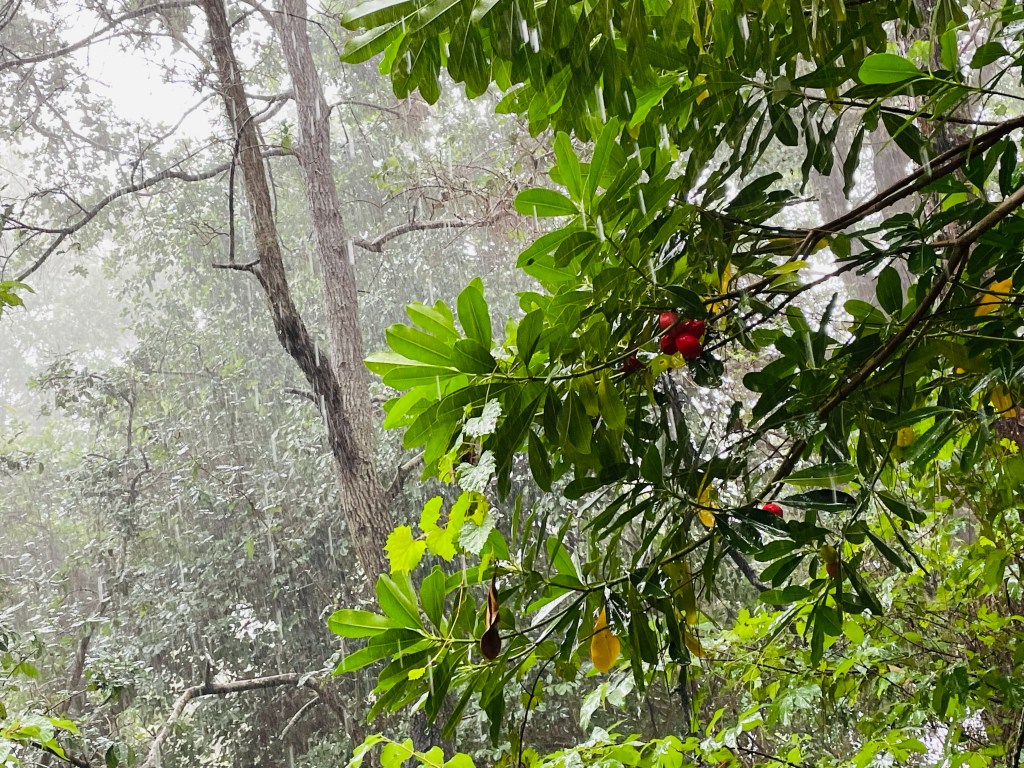
So what exactly made the timing of my visit to “Garden Of The Drops of Dew” as Morikami is commonly called so special? Know that upon arrival, I seemed to have “caught a break” as throngs of tourists at Morikami were rushing for cover to escape one of those typical South Florida rain showers that pass through during the approaching summer season. Yet I knew that these deluges did not usually last very long. Thus I felt free to conduct my self guided tour of Morikami’s unique landscape designs at a time when it’s paths were relatively clear of competing pedestrian traffic.
So I invite you to join with me amid the cooler aftermath of summer rain at Morikami in the photo set below. For I hope to recapture for you some highlights of this visit that best capture nature’s solitude there amid its flowering trees, shrubs, rocks ,and gravel in Japanese artistic tradition.
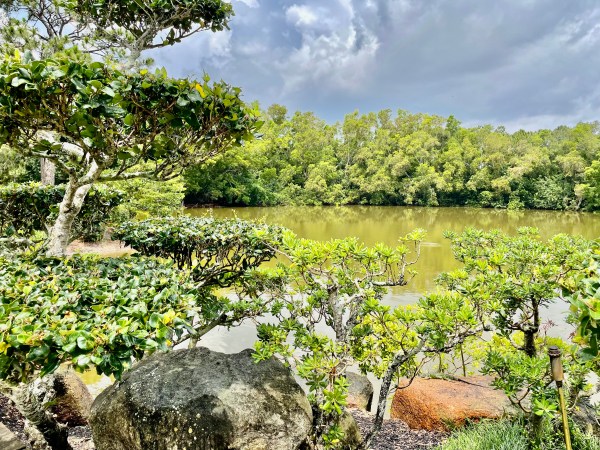
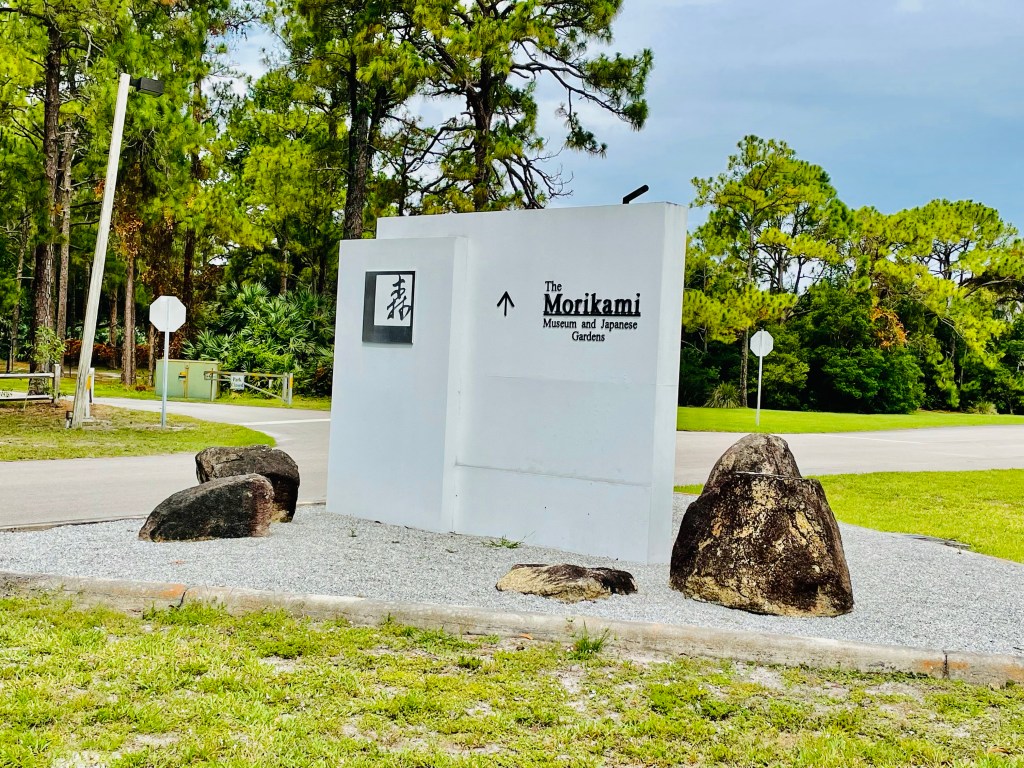
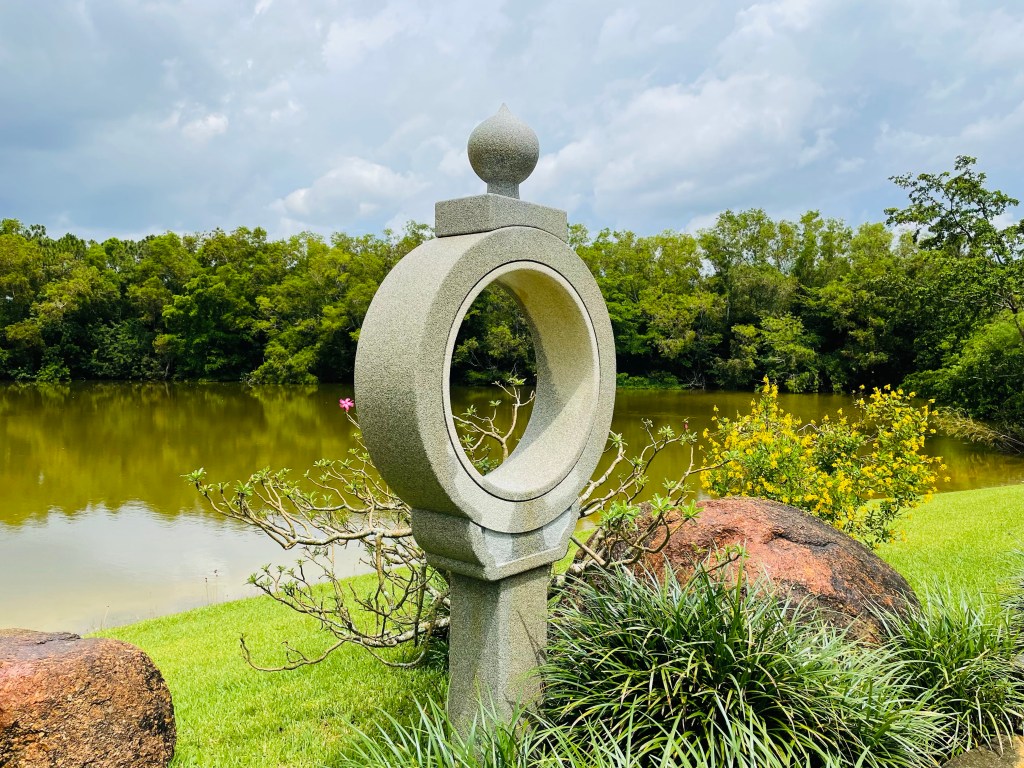
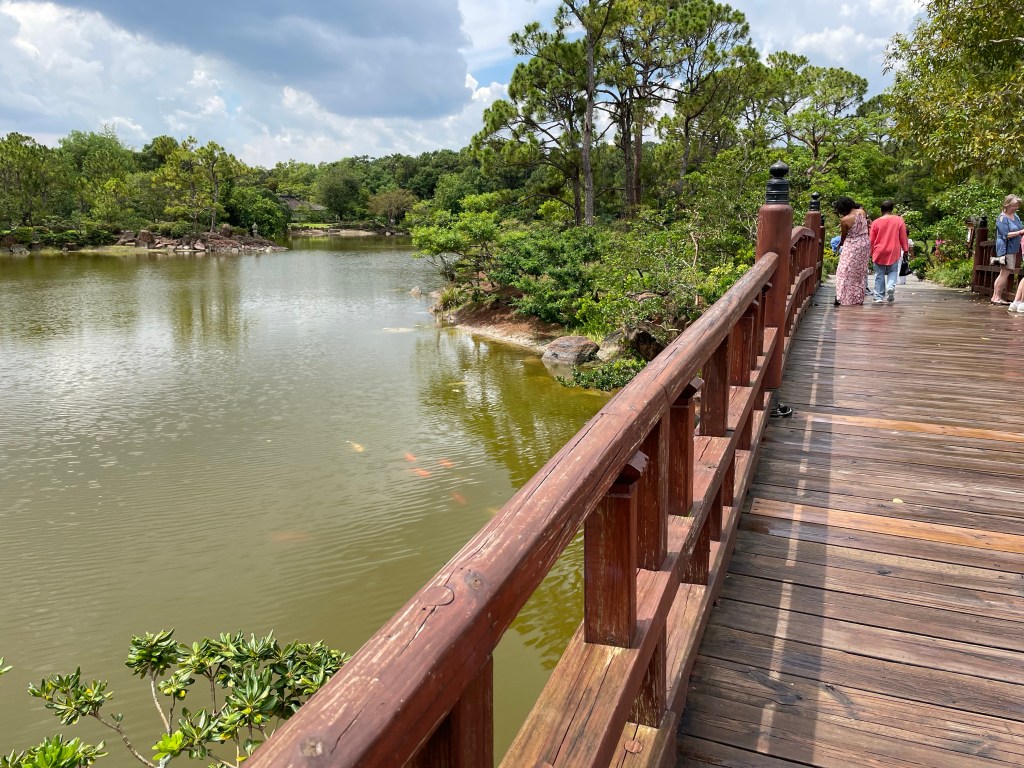
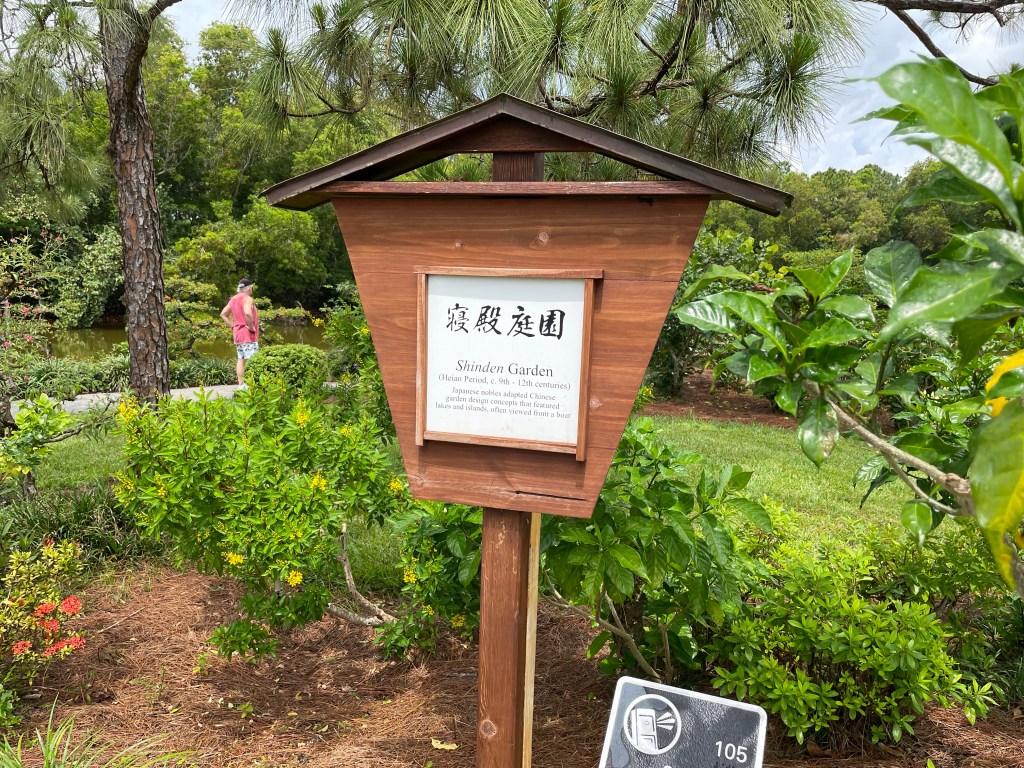
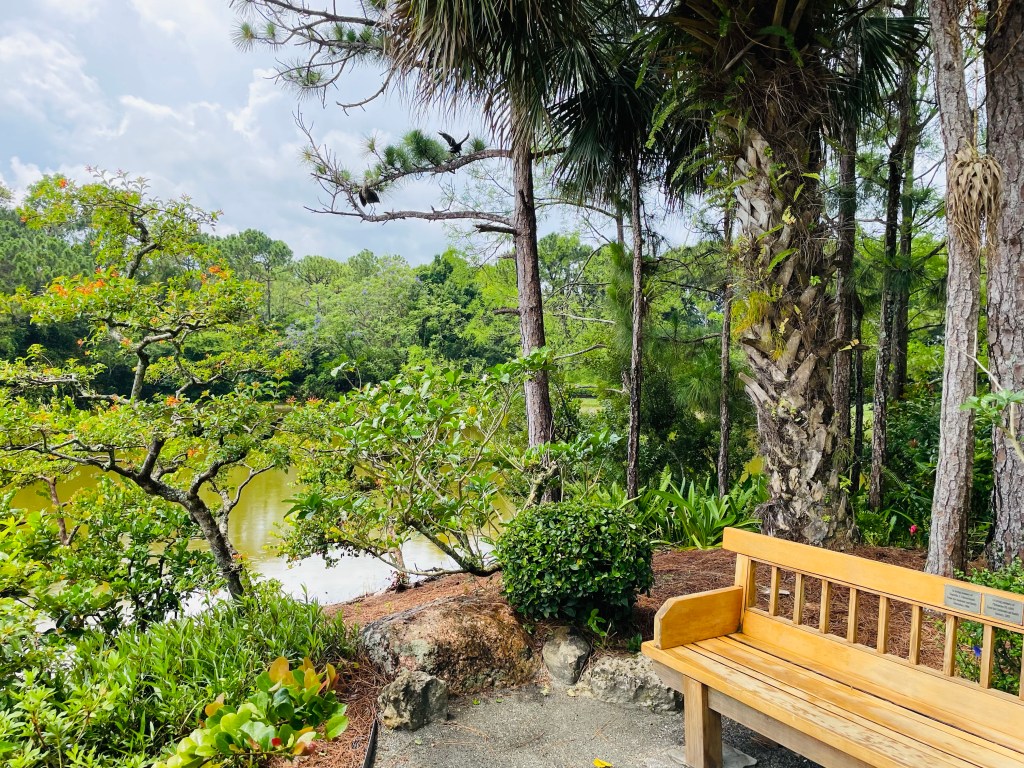
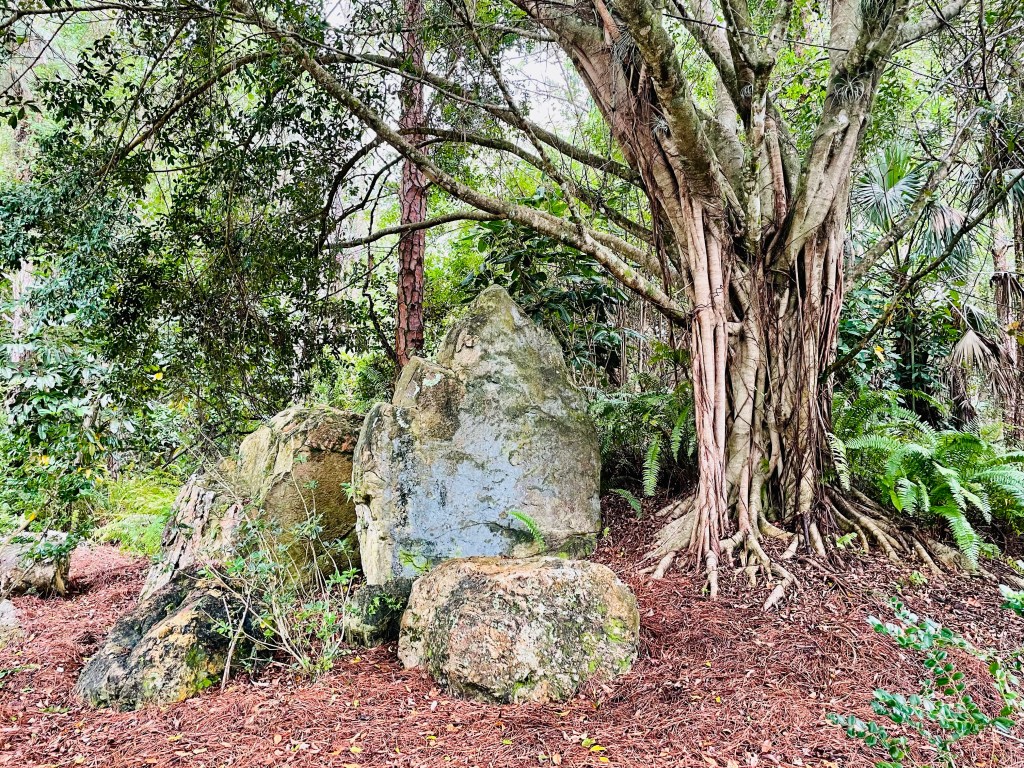
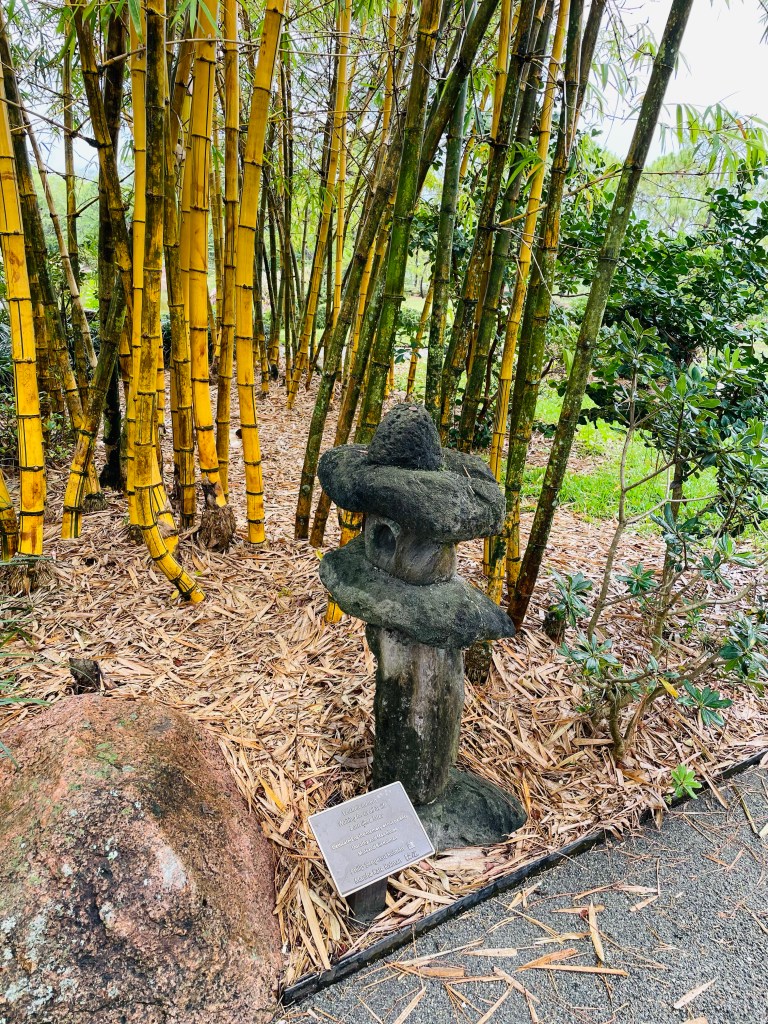
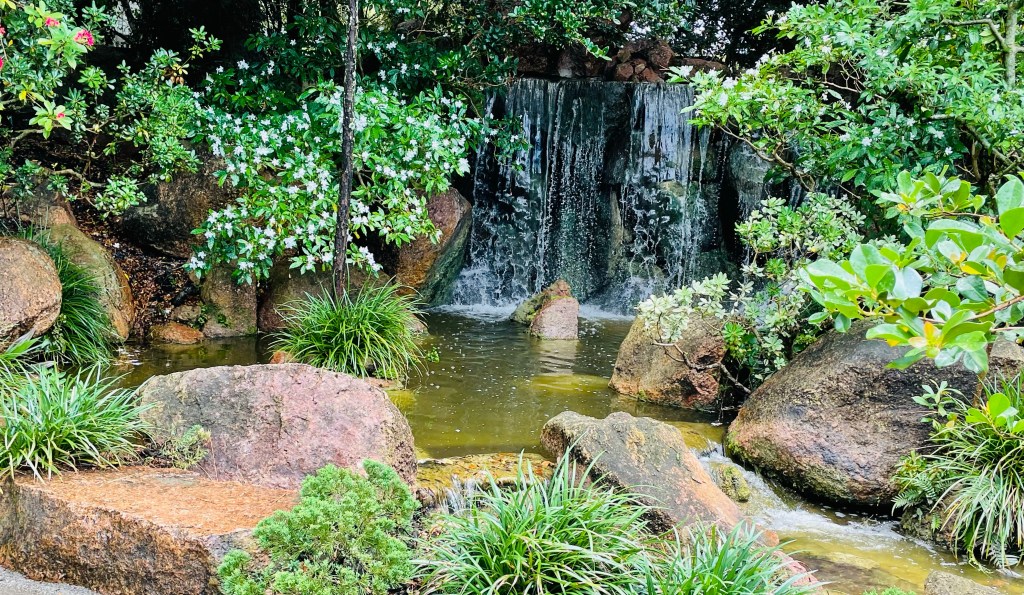
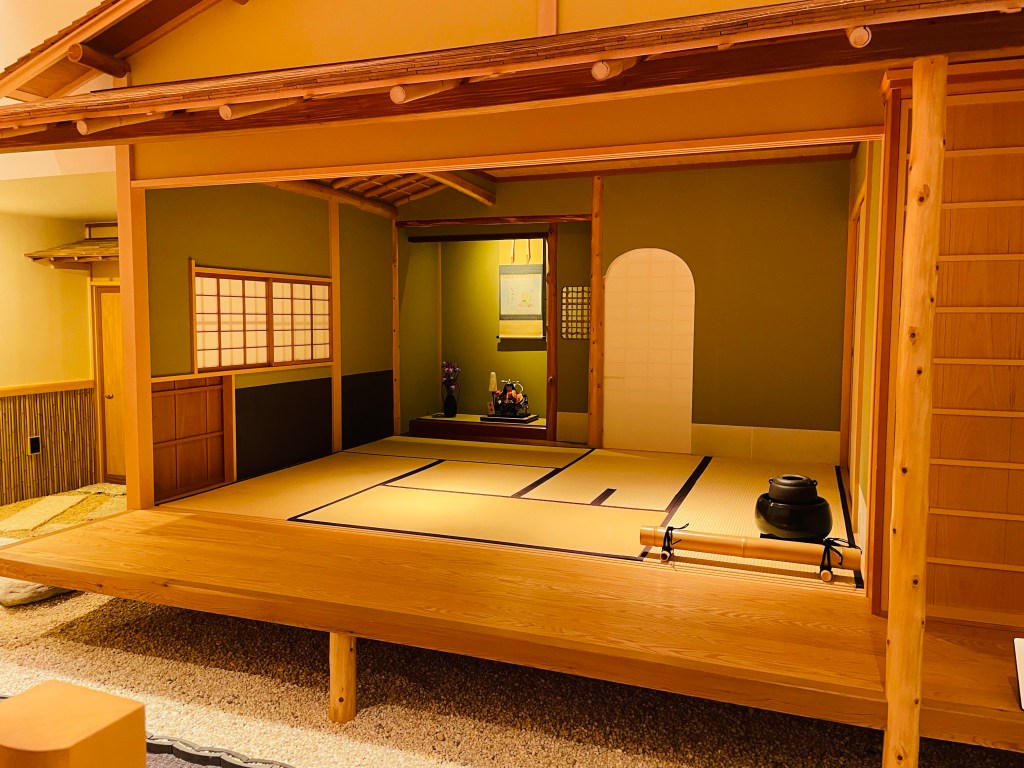
Pause at the Morikami front entrance and imagine a quiet oasis of natural beauty well buffered by surrounding forestland from populous surrounding cities.Before you enter the Morikami Visitor center, look around and take your first glance at Japanese precision in landscape design.Pick up a free Gardens map at the Visitor Center and plan your counterclockwise hike around a centralized pond in leisurely fashion.Be prepared to get rained on along today’s walk but plan to find spots along the way that can you duck under to seek cover.So let’s begin your tour at this stone lantern overlooking a quiet pond and settle into a dose of Buddhist spirituality.Cross over a simple wooden bridge and savor the brilliantly manicured gardens ahead that you will encounter today ahead on your loop route endeavor.As you walk through a series of several island gardens to the right of the lake, notice that colorful flower beds displayed in artful precision surround you. Now inhale the fresh smell of post rain dew.Sit down on a park bench to rest as needed as you gaze wondrously at stunning lakeside views.As you circle around the back portion of the central lake, notice the Japanese flair for using rock and gravel formations as a featured element in their landscape garden designs.Uh oh! It’s starting to lightning and thunder once again. You better duck under that covered pavilion ahead and listen closely to the inviting sights and sounds of rain in relative safety.With more rain approaching, you speed up your pace to the Visitor Center along the backstretch of your tour. So watch out for those large puddles and muddy tracks along the way.Now observe that a snowy egret and slender anhinga pose by the lake as a brief spell of sunshine has now returned.Just follow the gentle cascade of flowing water over these boulders to Morikami Falls for a pleasing end to your tour today.You’ve challenged yourself to complete an invigorating two mile hike today in the heat and humidity of South Florida summer. So you might feel the urge to remove your shoes and take a leisurely rest in this traditional Japanese tearoom.
“ Aging is not lost youth but a new stage of opportunity and strength.” (Betty Friedan)
When it comes to music, it’s a fair statement to say that originality can be a rare commodity to find as each age generation passes. For as the iconic bands of the past rapidly disappear from existence, their old songs become reborn in the burgeoning trend of Tribute bands today. Witness for example those wildly popular musical impersonators of Elvis Presley, Michael Jackson or Liberace along the famed strip in Las Vegas. Or venture into any wine bar, country hall or dinner theater establishment on a Saturday night and you can often hear American legends of pop music past like Willie Nelson, The Eagles or Tom Petty magically reappear for your enjoyment. Surprisingly, I’ve even observed directly that those memorable songs that I grew up with during the Vietnam War era inspire me to find common ground with today’s youth as well. Thus upon retirement from teaching a few years back, I took out my old trombone and tediously practiced my horn in order to ultimately play with a volunteer gathering of gifted high school students in such a classic rock branded band.
Perhaps you’ve noticed then that Tribute bands seem to pay homage to the idea that while we cannot stop aging of our body, the musical vibe we’ve enjoyed most can remain youthfully alive. So in this spirit of timeless optimism, I ask you to observe then the following song excerpts from four, retro minded, Tribute bands I’ve been paying great attention to lately. Do the melodies, harmonies, and rhythms of any particular tunes resonate for you as they once did in the past? Does any performance feature a charismatic lead vocalist who inspires attention to one of your previous musical idols on stage? Do the personalities of other band members stand out for you for any group as they often did before? Are you induced to dance or sing along in youthful vigor to the lyrics of a familiar song? Does the lighting or other special effects accentuate the stage “backdrop” appearance of one or more of these venues in a nostalgic way for you then? Would you be willing to remain for the traditional encore to hear that Tribute Band play on in lieu of exiting early to escape the crowd?
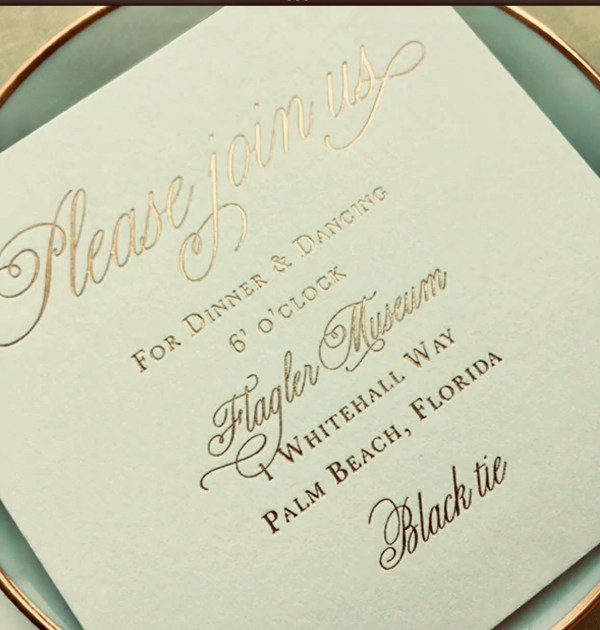
“More wonderful than any palace in Europe, grander and more magnificent than any other private dwelling in the world.” ( New York Herald description of Flagler’s Palm Beach Estate, 1902)
Imagine what life might have been like to join the filthy rich during the late 19th century, “Gilded Age” in America. It seems likely that one became inspired at that time by Rockefeller, Carnegie, or Vanderbilt to undertake great individual risk in order to obtain vast wealth from the rapid growth of business, technology, and industry. Yet I’m also intrigued about what kind of lifestyle might have best suited an aspiring entrepreneur then with such substantial profits looming at their future disposal? I assume then that one important strategy for solidifying one’s rank in this elite society could take place for one of these magnates by building a magnificent mansion to enjoy the fruits of their lifelong leisure passions.
Know then that such pervasive Gilded era displays of opulence still exist today on the exclusive, fourteen mile long island called Palm Beach, Florida. No I am not thinking of the tempestuous tycoon presence there of Donald Trump at Mar-a-Lago now. For on a recent visit to Palm Beach last week, I would instead experience the proud legacy of Henry D. Flagler, a man who more reasonably handled his sudden fame with both sound heart and mind at his Whitehall mansion during the early years of the 20th century.
So imagine this great captain of American transportation and commerce during the Gilded era eagerly celebrating his second marriage on August 24, 1901 to a sweet Southern lady, Mary Lily Kenyan. For a marriage gift, Mr. Flagler had decided to construct for his younger wife an elegantly designed mansion named Whitehall along the tranquil shoes of Lake Worth Bay He would thus spare no expense in constructing this new home with marble floors, painted ceilings, crystal chandeliers and and an indoor courtyard. A wrought iron fence around the the perimeter of the property would also secure maximum privacy for the Flagler family.
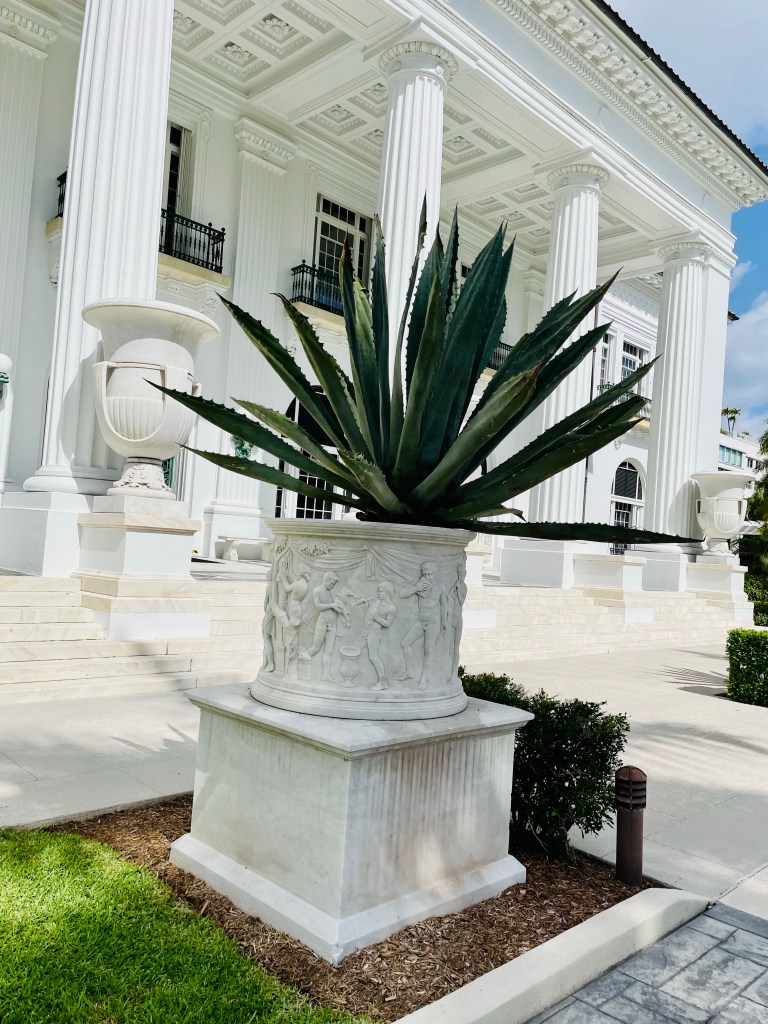
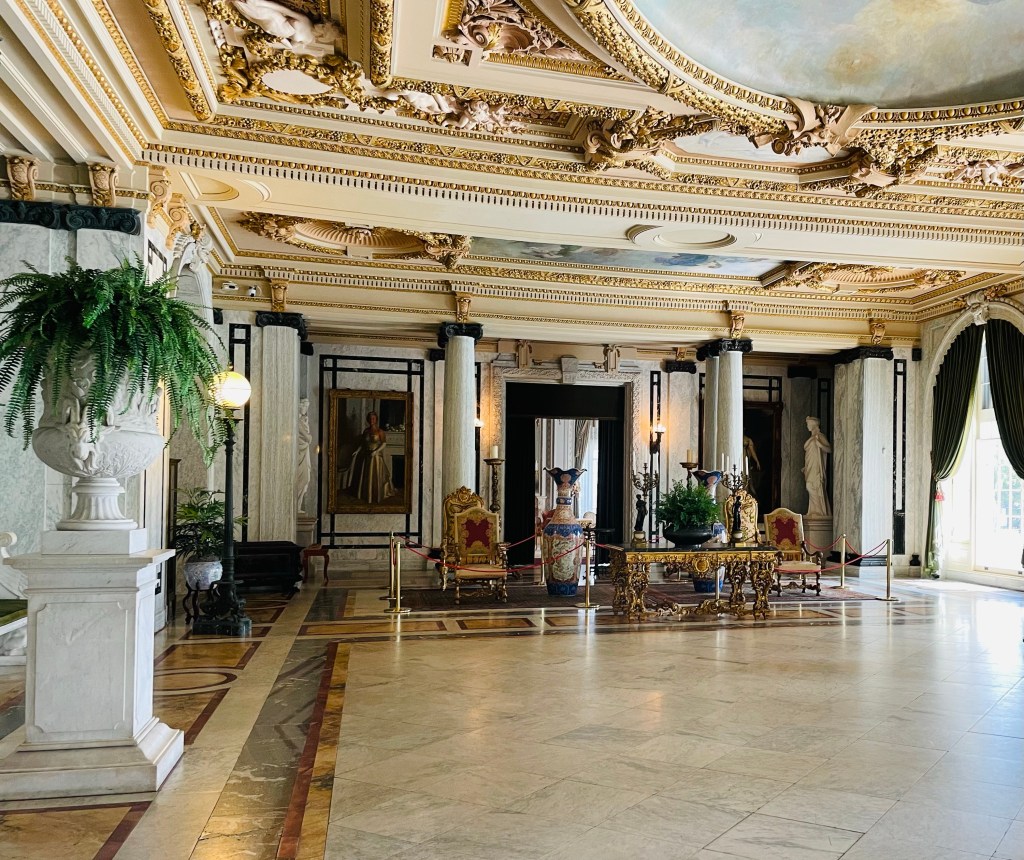
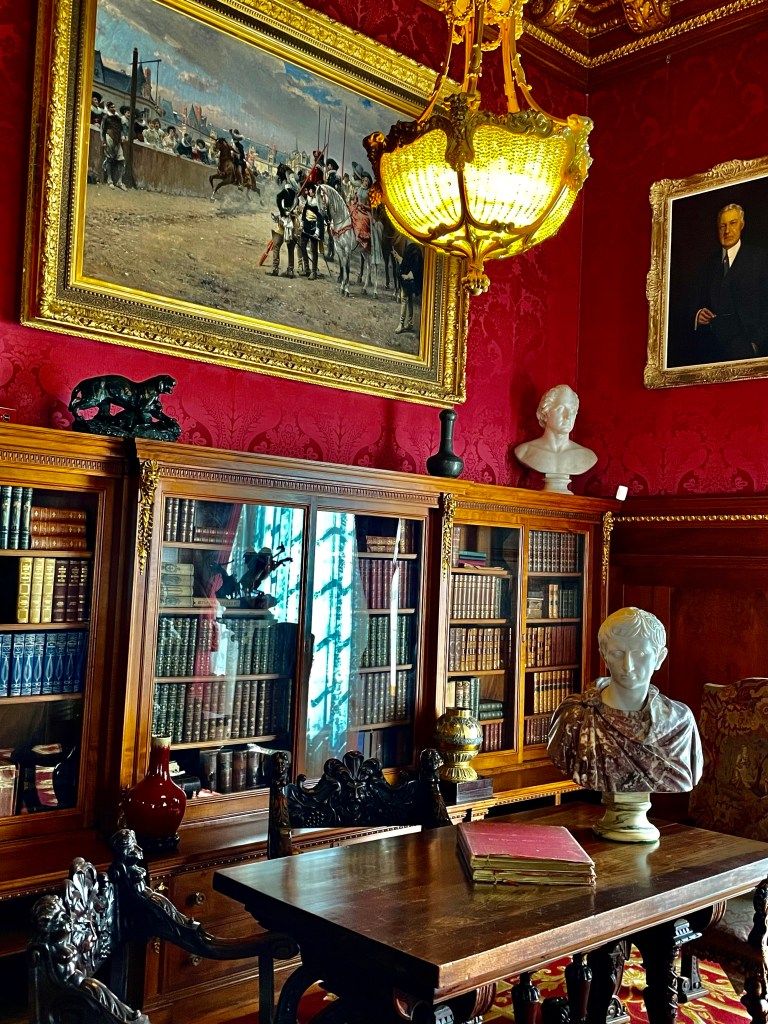
With such a grand wedding event taking place by Mr. and Mrs. Flagler at Whitehall on that momentous day, I’d been enthused that my actual visit to Whitehall last week might somehow offer me a rare opportunity to imagine traveling back in time as a guest of this festive wedding gala. So take a look at the following photos from our visit. For they might help you understand how that memorable wedding atmosphere that happened over hundred and twenty two years ago, seemed so real for me in 2022.
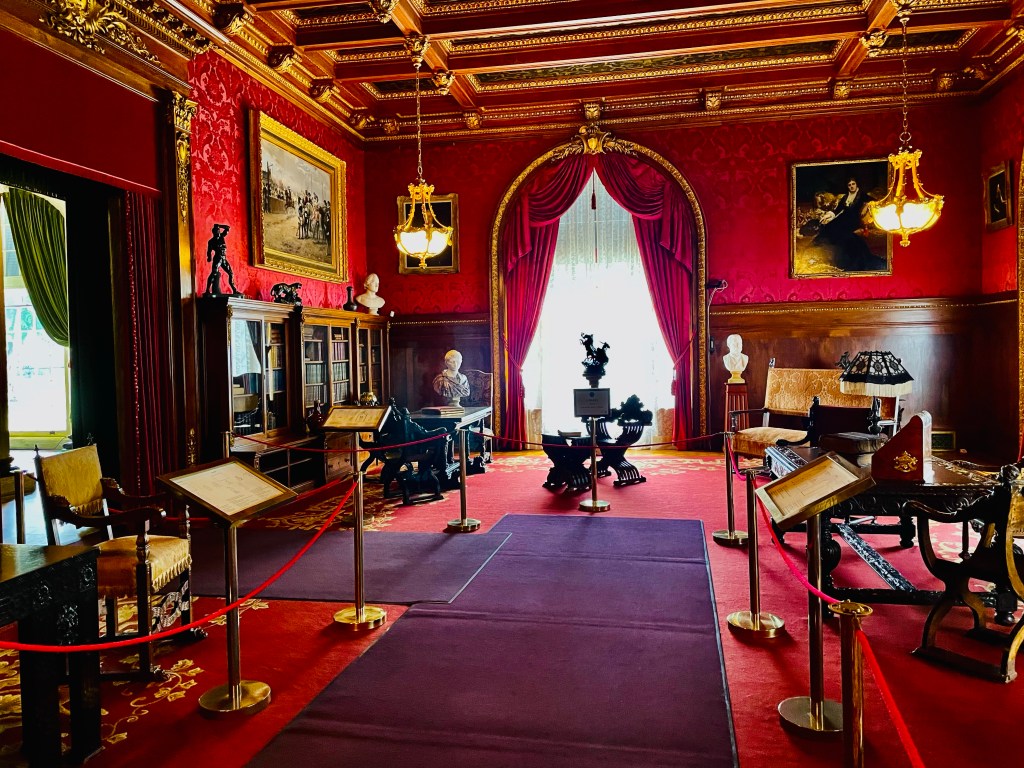
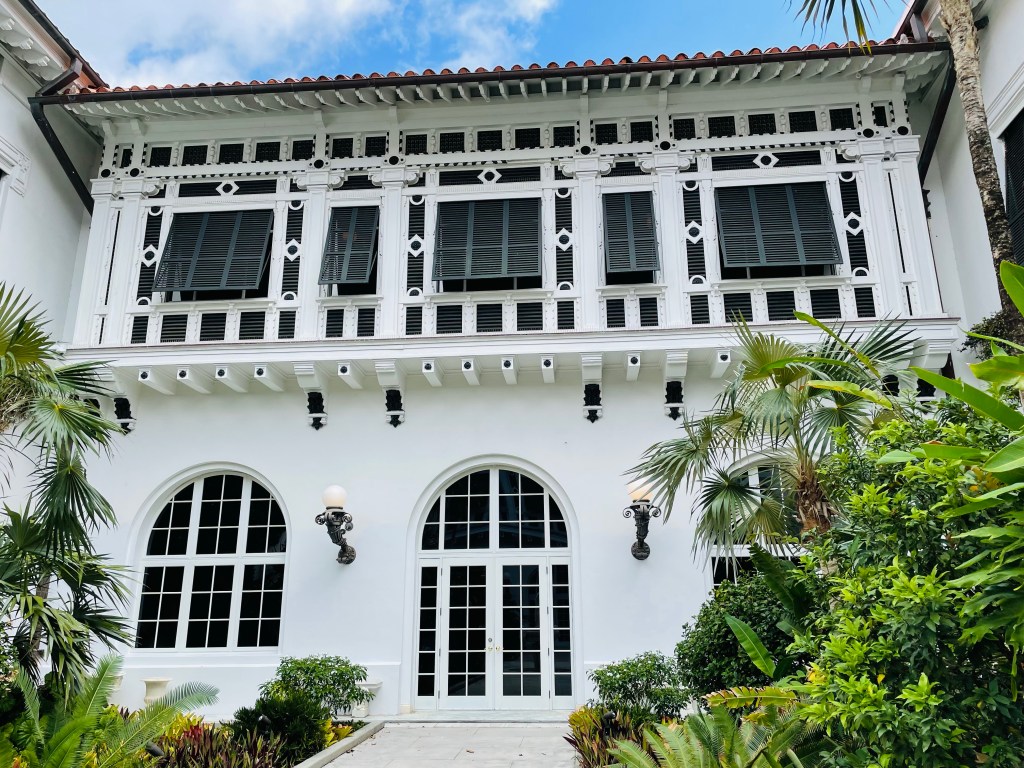
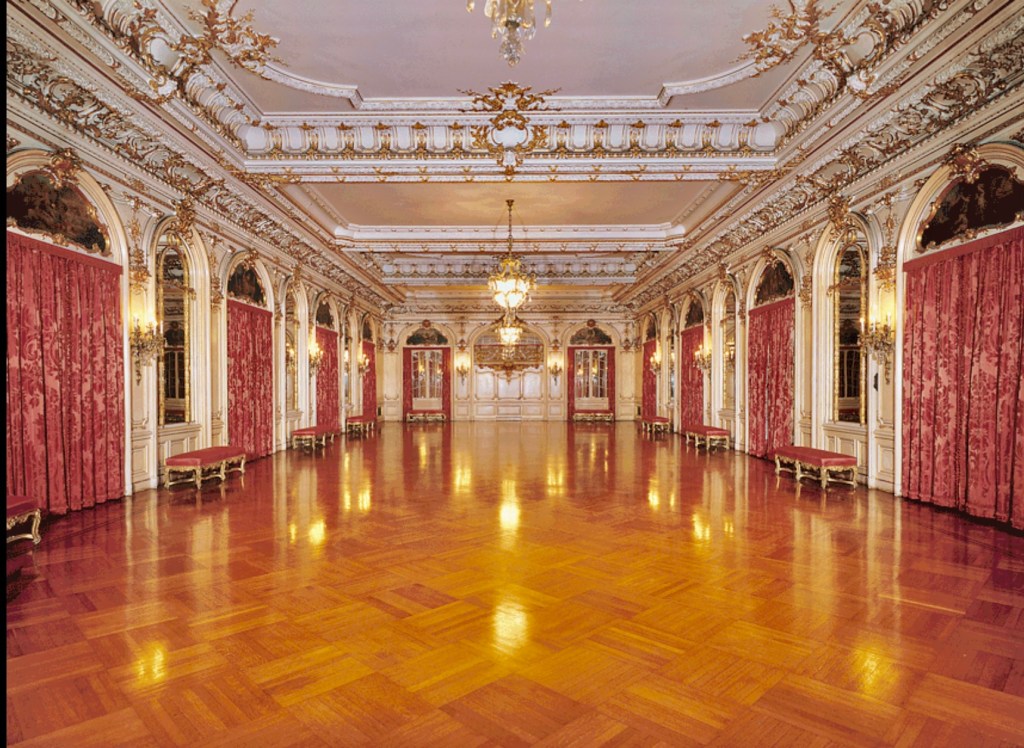
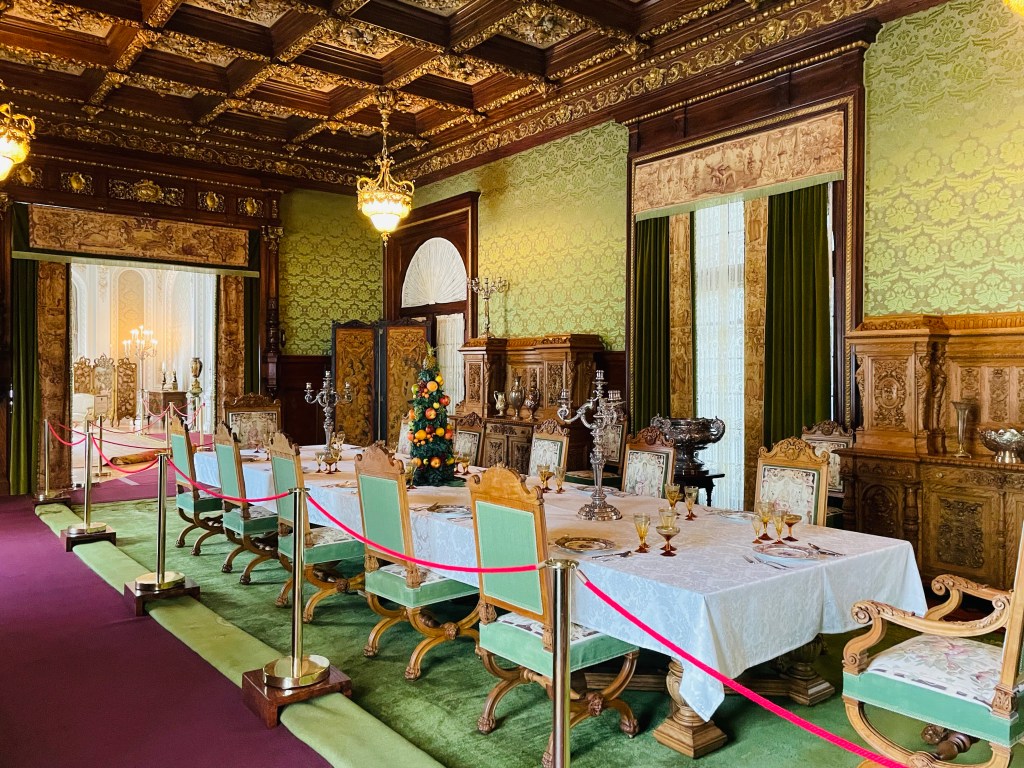
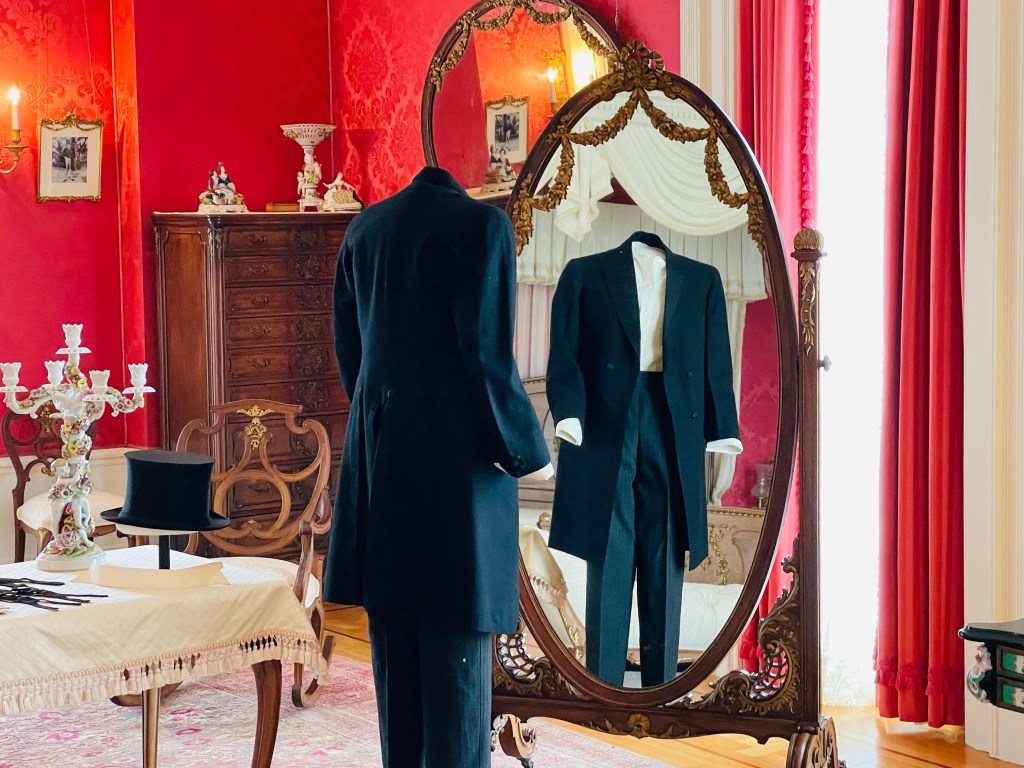
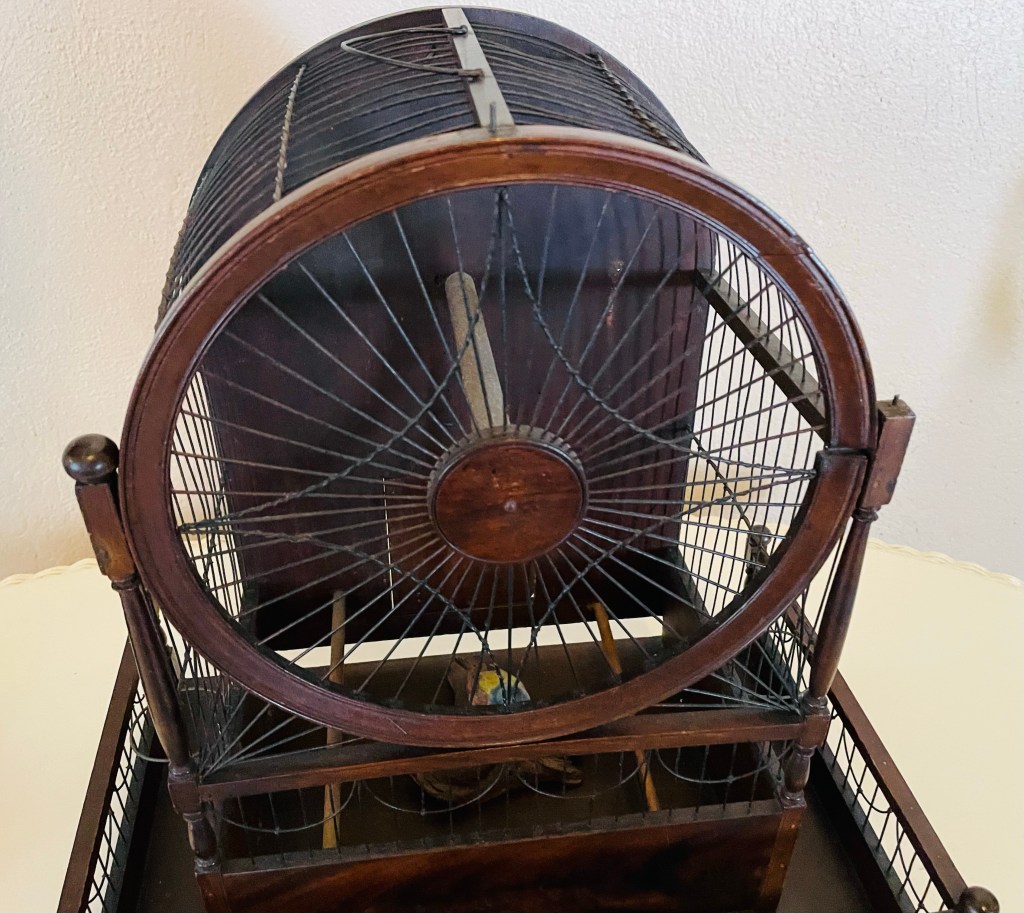
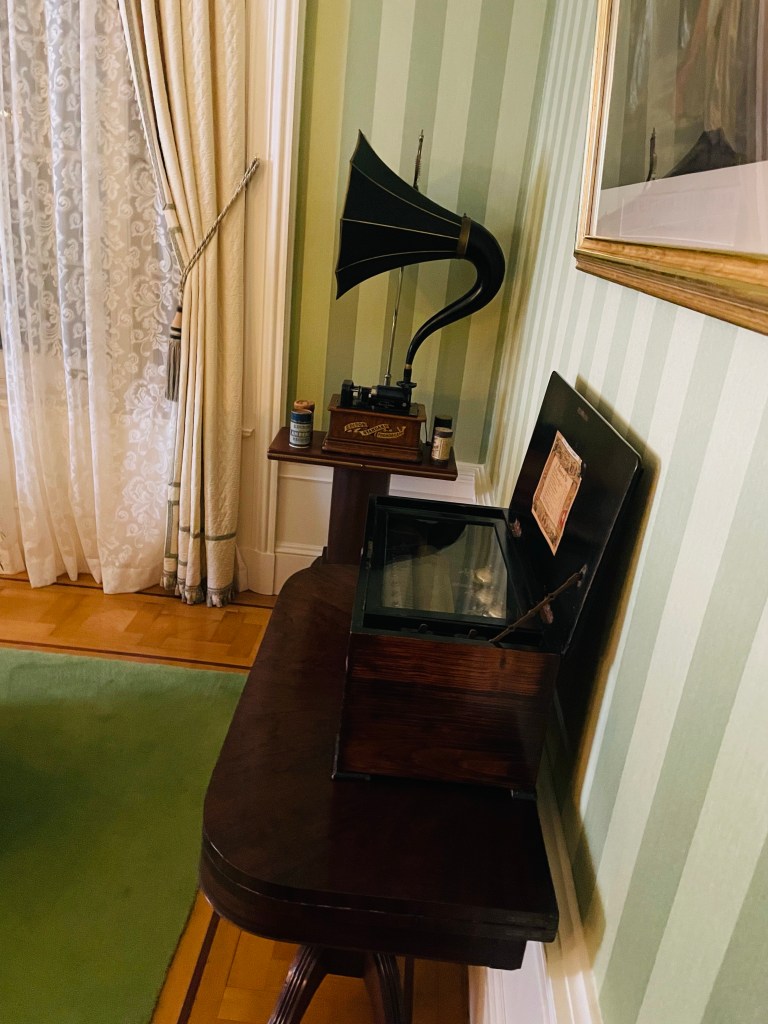
Whitehall Grounds – An inviting row of tall Coconut Palms would lead me to the impressive front entrance of the mansion dedicated to the ordered world of Greek Mythology symbolism.Grand Hall – This 5,000 foot reception room inspired my curiosity in an impressive array of artifacts representing the evolution Western culture, art and literature..Library – In this boldly red lined room of ornate design, I discovered a quiet place to seek intellectual pursuit away from surrounding crowd activity.Music Room – How special it must have been to hear a resident musician expertly play musical masterpieces on this pipe organ in Gilded era times for a captivating audience.Courtyard – At mid point of my tour, I paused to refresh my physical stamina amid the fresh ocean breezes and tropical foliage of this open setting.Grand Ballroom – Now lying in vacant stillness at the center of the Whitehall complex, strong visions of romance inspired dance and music filled my mind as I passed by this spacious Grand Ballroom.Dining Room – I seemed to register a boost to my self esteem imagining that I could be seated as a privileged dining guest of importance at this elegant, French royalty table.Drawing Room – My sociable wife Ruth would undoubtedly have enjoyed the casual conversation with female guests in this informally suitable setting.Guest Bedroom – I wonder about any changes in myself and my dealings with others I if I had worn such formal attire typical of the Gilded Era period.Master Suite – Given the chance to take a nap in this spacious bedroom of original French furniture, I’m certain that I would have made good use of the telephone, fan, phonograph as well as other technology conveniences of the period found nearby.Flagler Pavilion – I’m curious to know what the east coast of Florida must have looked like traveling as Mr. Flagler’s honored wedding guest along wilderness land on Henry Flagler’s original rail car south to Palm Beach during those Gilded Era times.Railway Seating Booth – On my way home from the raucous Whitehall party, I would undoubtedly enjoy being pampered with hot tea and other refreshments in first class comfort as I gazed wondrously out my passenger window.
Hi Friends: I’m in the process of making some changes to my Word Press website. I would appreciate if you would complete the brief survey. If you don’t see the survey, click once on the blog title or picture to access it. Thanks. USFMAN
Hello Readers: I’m experiencing some storage space limitations with the thousands of photos I’ve compiled on Word Press over the last five years. So I decided to do some spring cleaning now and purge a manageable collection of my past blogs. Please let me know if there’s a particular blog erased that you would like me to repost. Thank you. USFMAN
“We don’t see things as they are. We see them as we are.” (Anais Nin)
The concept of perfect does not exist as a viable concept in my life. Thus it’s totally wrong to expect my reality in travel to unfold in a perfectly idealized manner. Yet during those curious wanderings that sometimes seem mistake-prone at the time, I strongly envision ways to change my world for the better.
Let’s take the obvious flawed appearance of the historic Leaning Tower of Pisa in Italy. For how might its legendary angled position influence my future life in a more positive way as I reflect back to our past tour of these hallowed grounds? Perhaps I could now realize the greater needs to stand up straight to gain greater confidence in oneself and avoid back ailments caused by such excessive slouching. Or closer to home, why would I become consistently repelled by the monotonous blight of high rise condos when visiting the beaches of South Florida? It seems that I’m just perceiving them as ugly wall barriers of tourist driven profit that fuel my desire for actively protesting at local zoning meetings to preserve more public beachfront land.
So take a long look at the following photos. I challenge you to consider how you could transform each of these travel scenes depicting signs of negative imperfection into more dazzling deeds of importance in your own life.
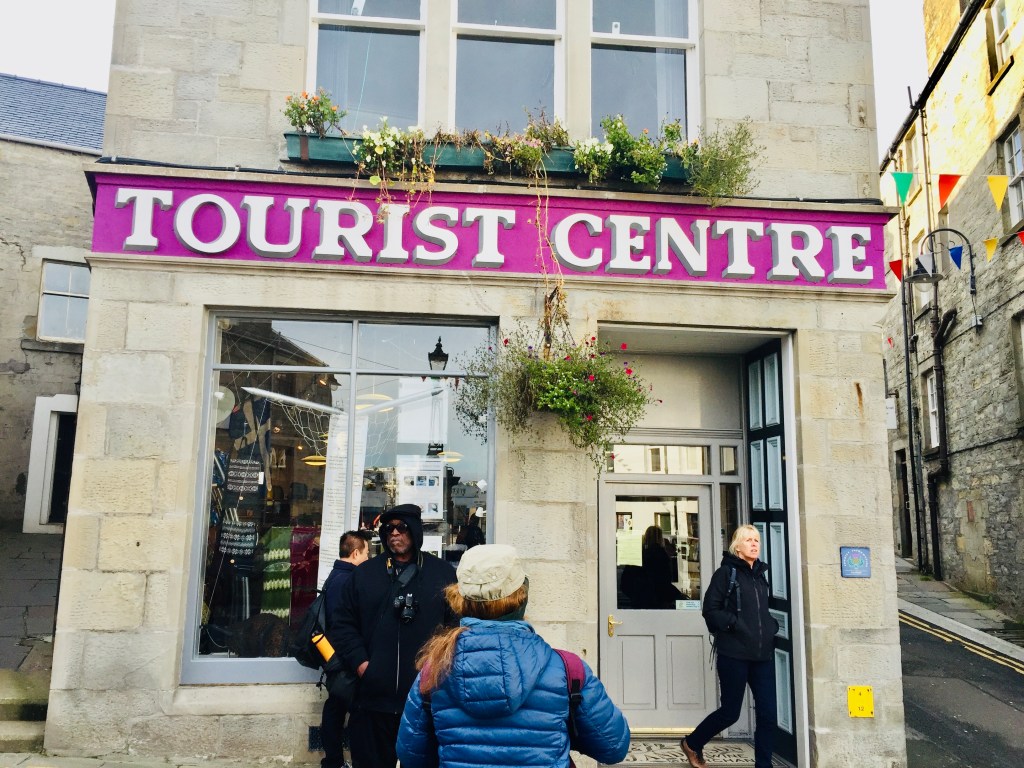
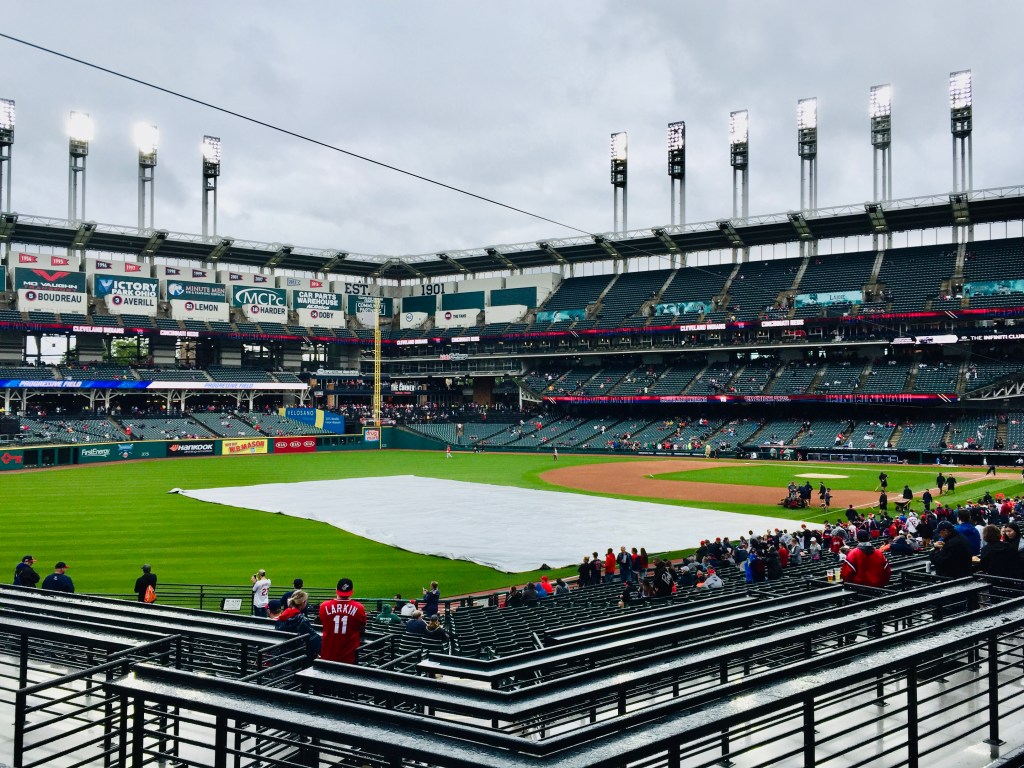
PARIS, FRANCE – What point would it make to walk along the beautiful Seine River environs preoccupied only with checking your I-Phone?LERWICK, SHETLAND ISLANDS – What kind of human interaction does a visitor to a new town expect to receive at a busy Tourist Office instead of enduring a long wait with strangers freezing outside the building for their turn to enter?NEW ORLEANS, FRANCE – If a public sign forbids a driver from pulling over their vehicle anytime at this strategic spot on this busy street, how likely does it seem that the he/she will actually notice this obscure, restaurant entrance signal?DUBLIN, SOUTH IRELAND – Why would one desire to book a carriage ride tour that features an obscure view of industrial blight along a towering wall?CLEVELAND, OHIO – To what extent does a rain delay requiring an extended tarpaulin cover of the field interfere with the “natural” flow of summertime enjoyment outside during a live baseball game?CHICAGO, ILLINOIS – From a sight and sound perspective, why do ticket promoters offer tickets to buy behind the stage at stadium concerts?ROME, ITALY – If a cafe offers outdoor seating, then shouldn’t there be enough chairs and tables to make this concept work?LOS ANGELES, CALIFORNIA – Big cities provide plenty of exciting tourist opportunities but how can one enjoy moving to and from these sites with so little fresh air to breathe?HALIFAX, NOVA SCOTIA CANADA – If you want to convince people to recycle food and used goods, then why make it so complicated to do so?
Live in the sunshine, swim the sea, drink the wild air. ” (Ralph Waldo Emerson)
Imagine a vast Everglades of primitive swamp wilderness transformed in a little over one hundred years into a dense urban megalopolis called South Florida. Nowadays, close to ten million people reside along this narrow strip of land stretching north to south in Palm Beach , Broward, and Dade County along the southeast coast of Florida. Envision further a heavy infiltration of visitors and part time residents from northeastern U.S. states, French Canadian Quebec and various other Latin American countries each winter-spring times in south Florida during what’s commonly called “The Season.” Thus begins the mad scramble of human competition to enjoy our coastal sun, sea, and air amenities for these four to six months of the year. So for this longtime Fort Lauderdale resident, you might understand why I diligently search during “The Season” to find accessible spots for peace and quiet along this congested beachfront coastline.
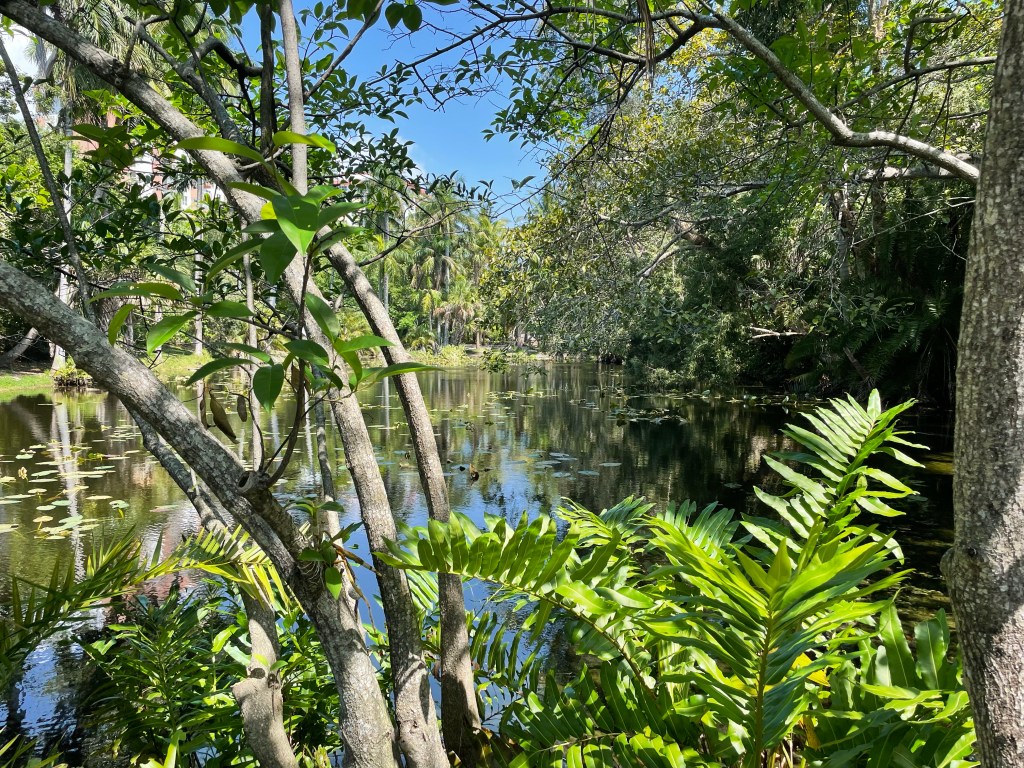
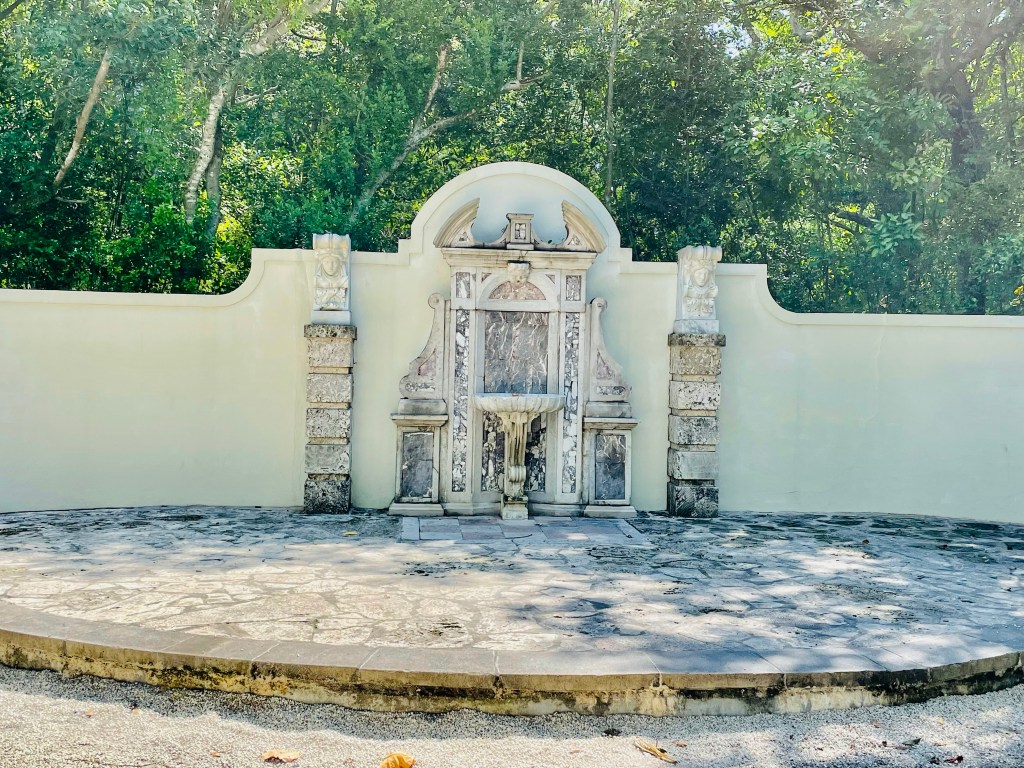
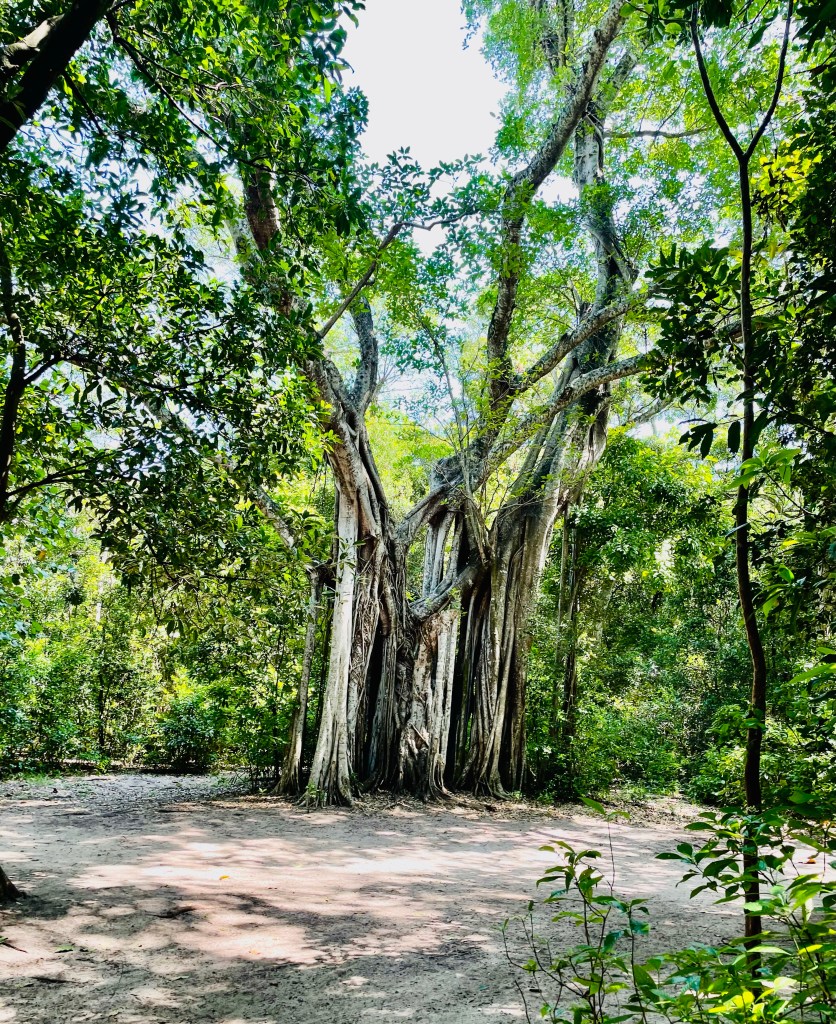
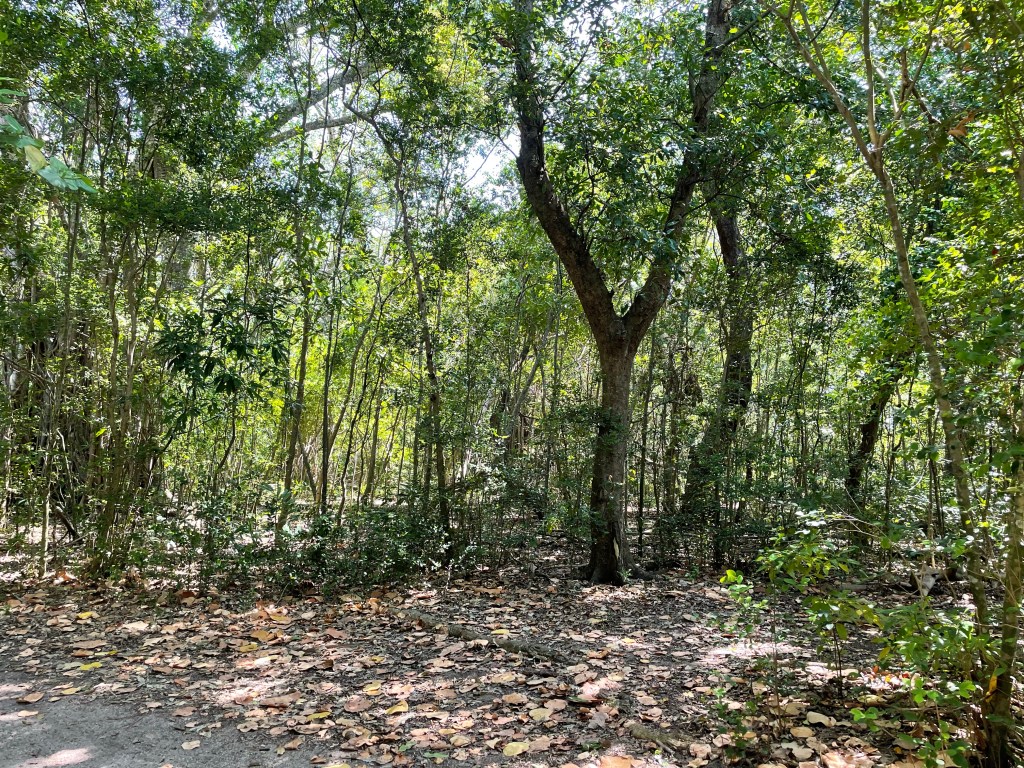
Consider as well my reasoning for making a first time visit last week to the “Bonnet House Estate and Museum, a historic landmark of notable interest within the popular Fort Lauderdale beach district of Fort Lauderdale. In one sense, Bonnet House estate’s thirty five acre “protected” expanse of lush tropical vegetation and gently rising sand dune formations functions most prominently as as one of the few remaining coastal “protected” areas in Broward County to buffer urbanized areas westward from feeling the destructive effects of our annual hurricane season. Yet this so named barrier island encounter on my day trip felt so much much more to me than a dividing juncture to block wind or rain disaster inland. For as I casually strolled this unique oasis showcasing so many artistic, architectural, and ecological gems along this self guided trail, I’d realized that I’d also stumbled upon a special place to relax amid nature away from the “maddening crowd.” Some upcoming nature events to be held in 2022 at the Bonnet Complex that “caught my attention” included the Orchid & Garden Festival, a “forest bathing” walk” and various birdwatching classes.
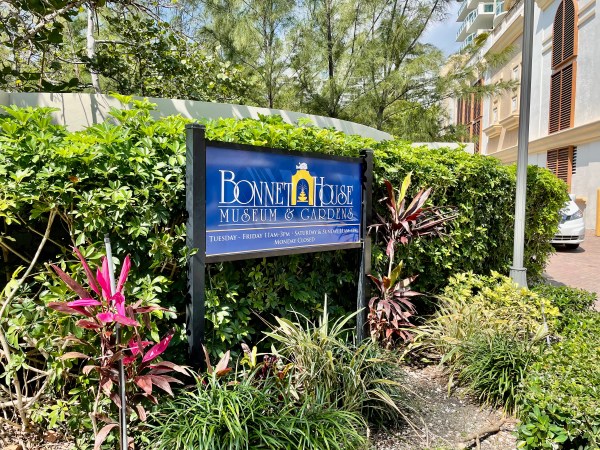
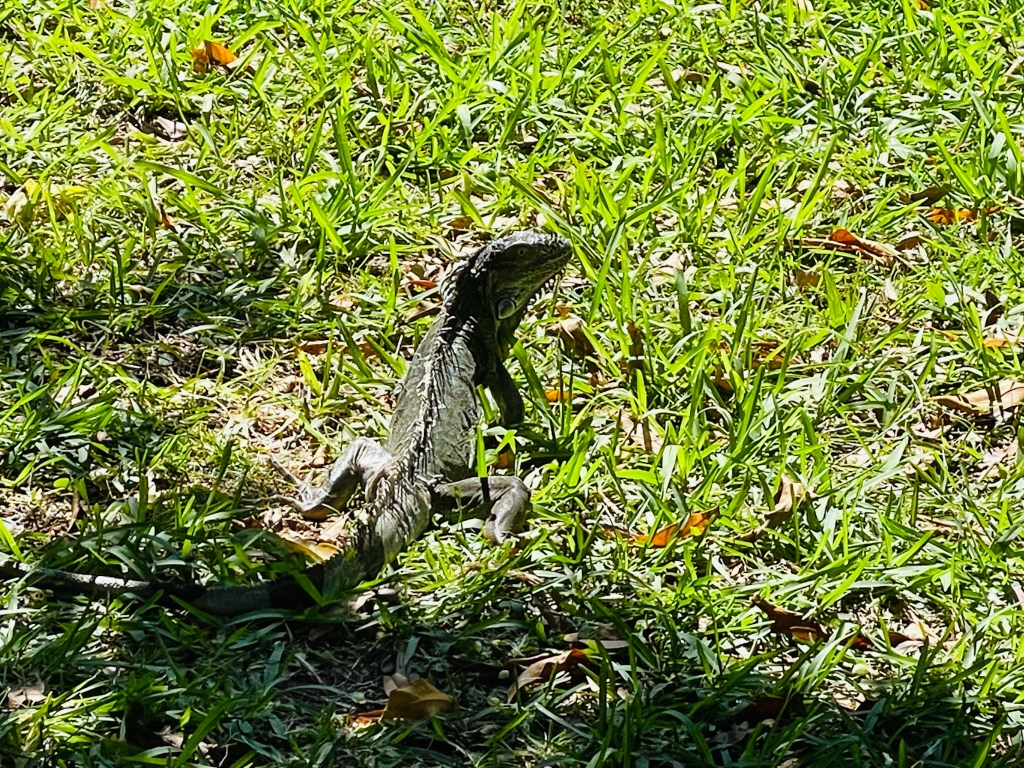
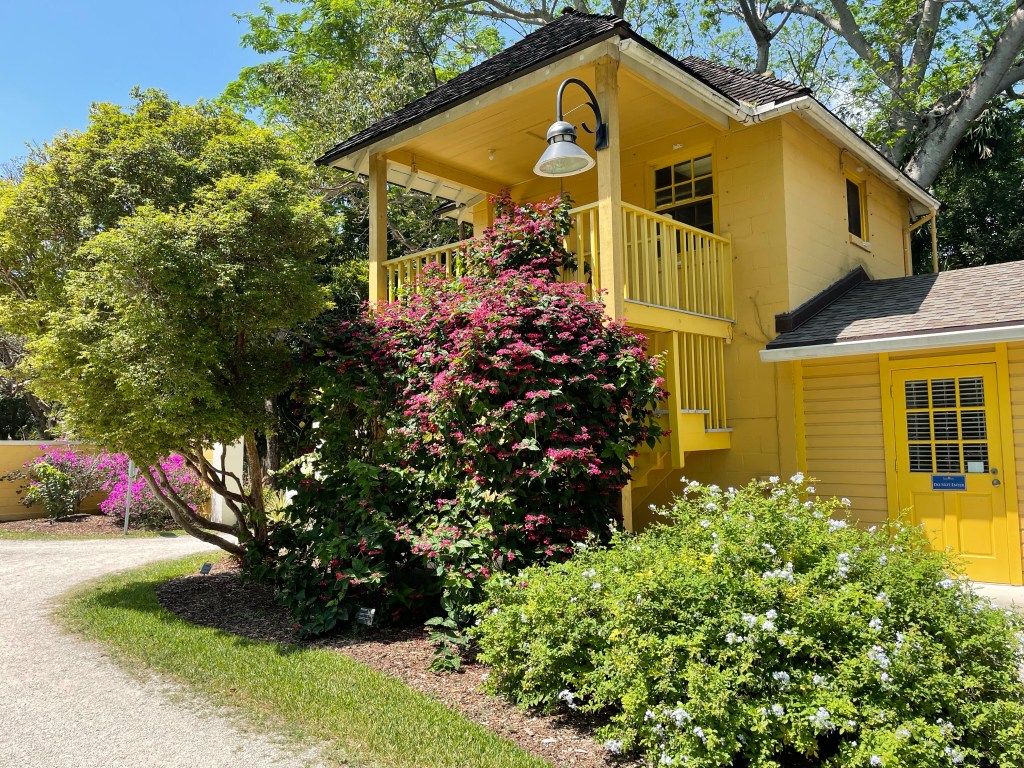
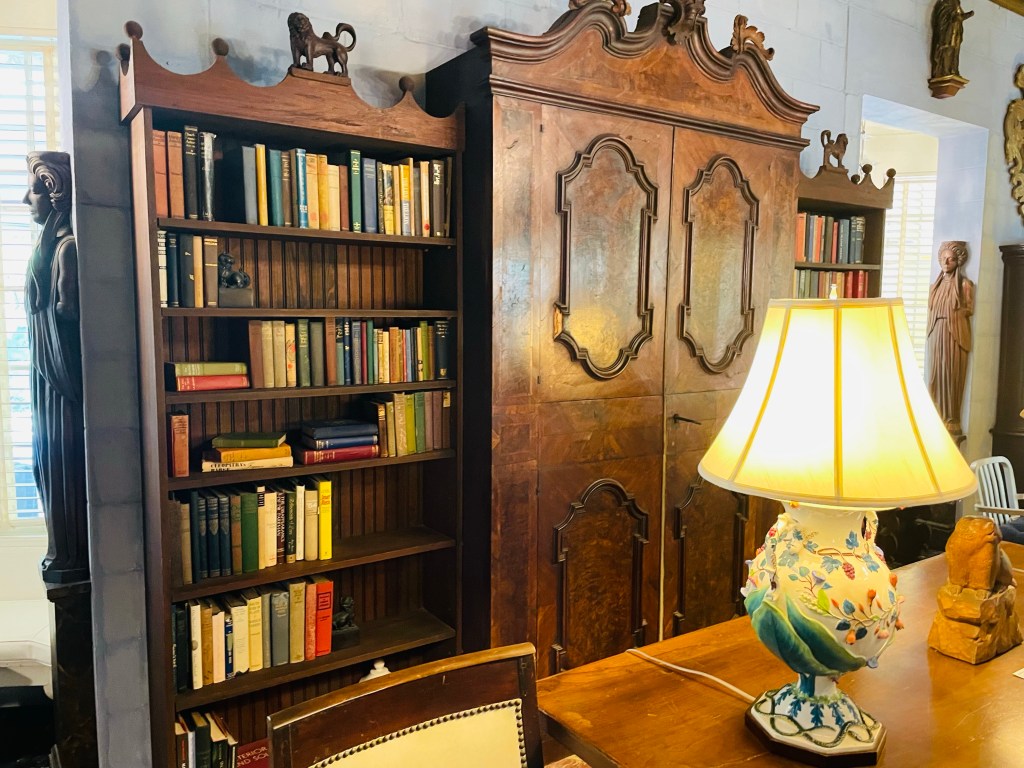
At first entry to the Bonnet Museum Complex, this conspicuous signpost revealed the historical significance of the landmark originally built for the original owners Frederick and Evelyn Bartlett in the 1920s.At the Welcome Center, I downloaded on my I phone an audio tour to learn more information about the various spots specified on the tour map to visit along my self guided route.Notice the steady encroachment of “high rise” residential development surrounding the private Bonnet property.At an area called the Experimental Grove, I relaxed under the pleasing shade of various fruit trees lying atop the protected dunes.This curious iguana did not seem bothered my human presence at a nearby picnic table.The freshwater lagoon known as Bonnet Slough provided plenty of binocular action for me to spot birds and various aquatic animals.The striking blue and white pavilion spot observed today marked a historic place where weddings, movies, and celebrity photo shots have happened over the years.Notice this massive Banyan Tree better known as the “Tree of Life” still standing prominently as I crossed through the coastal hammock.This dense “Hardwood” tree hammock forming the easterly boundary of the Bonnet Estate functions as a wall of natural growth separation to buffer the property from the ravages of tidal erosion, and tropical winds and rain.Bonnet’s famous orchid collection lies in this inviting ” Greenhouse” , opening for private tours only.A dramatic crossover of the lagoon over a Seminole Indian Chickee Bridge led to the Bonnet Mansion. This yellow building originally used as servant worker quarters at the Bonnet Estate now houses the Museum Shop.The official entrance to the Bonnet House Mansion on my tour took place through a spacious courtyard functioning as a lush tropical garden.The walls of the mansion courtyard showcased an extensive interest in animal artwork and aesthetic appreciation of nature.The interior rooms of the mansion revealed a Bartlett family’s taste for music, art, and literary enjoyment








































You must be logged in to post a comment.